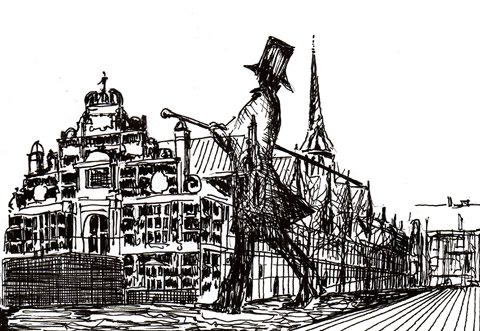
A legislative supremacist’s case: why the American constitutional order keeps tilting toward one-person rule, and why the repair has to happen in Congress, not the presidency.
If there were a single concept from economics I’d like to see more widely understood, it would be adverse selection: the tendency for markets to sort participants into worse and worse pools when one side of a transaction knows more than the other. The idea originates in a 1970 paper by George Akerlof, “The Market…
I tested whether AI could approximate a developmental editor, built a tool called Apodictic, and learned surprising lessons about writing craft, reader contract, and the real limits of large language models.
My friend Peter Levine wrote recently about how much of the public unease about AI consciousness comes from something surprisingly mundane: the interface says “I.” When Google’s Gemini delivers information in the third person, it’s just a tool; when ChatGPT says “I can help you,” some users start composing rescue missions for the trapped digital…
Apparently context is scarce. Here’s some: “Democratic party politics is urban machine politics, scaled up” from Noah Smith A variety of activists and special interests — collectively known as “The Groups” — can basically persuade Democratic staffers and politicians of their ideas in the proverbial smoke-filled rooms, well out of the public eye. Democrats’ focus…
After getting the same Vera Institute of Justice messaging presentation twice on Friday, I’ve been thinking about what messaging consultants are actually trying to do.The average messaging summit is a triangulation between three things:* What the consultants’ funders want* What their pollsters tell them voters like* What the audience of candidates, staffers, and pundits needs…
Most people know the story: Tom and Joe are fishing on a boat in the middle of the river, when they spot a baby floating past. Joe tosses his pole and jumps into the water to save the child, and Tom helps him back into the boat, checking on the infant. They’re rowing back to…
It’d be nice if the folks who don’t believe in global warming weren’t polluting the same world as the folks who do, but the tragedy of existence is that we must share one world. No one sane and good is ever a relativist or a pragmatist about criminal guilt or ignorance, about child abuse and the Satanic panic, or about vaccines. Relativism is always reserved for some other stuff that’s off to the side, like whether a particular artwork is beautiful.
The internet can sometimes disappoint you, but sometimes it can be so very, very satisfying. When you’re quote-hunting these days, it’s usually just a disappointment. For instance: I have long loved a quotation from Gustave Flaubert that is translated as follows: “Be regular and ordinary in your life, so you can be violent and original…
Rascal News is an exciting new venture in tabletop games journalism. Building on the 00s’ New Games Journalism for videogames, the editors/authors are Lin Codega, Rowan Zeoli, and Chase Carter. A recent interview with Kimi Hughes discusses “How Has Actual Play Changed Game Design?” Some sources and inspirations: Gen Con’s Ennies Elizsabeth De Kleer’s Vice Writing on D&D in prisons and Critical Distance’s Best writing on…
Nasreddin got himself into some serious legal trouble–the reasons are lost to time. Before the king sentenced him to death, Nasreddin asked for a delay because he was the only person in the world who could teach a horse to sing. The king was skeptical, but gave Nasreddin a horse and a year to teach…
I am teaching this course again. Every year it changes, and this year I hope it changes a lot. Here’s what I said about this today, our first day of classes: Any story about crime and punishment is bound to start with a few stylized facts. Until this year, I’ve started with the same number:…
What worries me about Silicon Valley’s mindfulness stoicism is the sense that it combines all the worst elements of world mastery and manliness with the stoicism of the weak: acceptance of injustice, the embrace of a hostile natural (and social!) world to which we must conform, and a quietism that locates our agency in that compliance while praising it as mastery.
I wrote this little primer at the bottom of a long discussion of the Schocken Books editions of Arendt’s work, and then reposted it a while back on Facebook. It’s been popular, so I’m reposting it again here so I can easily link to it without feeding social media. Race-thinking precedes racism. Arendt’s analysis of…
“My child is dead, and someone must pay.” There are no words that make so much sense to me as these. People say “I can’t imagine what it would be like”—but I can. I do. It’s bound up with my love for my daughters, my joy at their growth, and my hopes for their future….
Propublica thinks so: What Can Mayors Do When the Police Stop Doing Their Jobs? Rises and falls in crime rates are notoriously hard to explain definitively. Scholars still don’t agree on the causes of a decades long nationwide decline in crime. Still, some academics who have studied the phenomenon in recent years see evidence that rising rates of…
Georgetown has been committed to teaching in prisons in one way or another for almost forty years. The support of the Andrew W. Mellon Foundation will allow us to redouble that commitment, with a bachelor’s degree and an expanded footprint in Maryland.
I’m speaking today at the RAND Corporation on “Career Prospects for People with Criminal Records.” While I’m there, I’ll speak about our work at the Prisons and Justice Initiative (founded by Marc Howard) at Georgetown University, focusing on the education work: the Scholars Program, the Paralegal Program, and the Pivot Program. In addition to discussing…
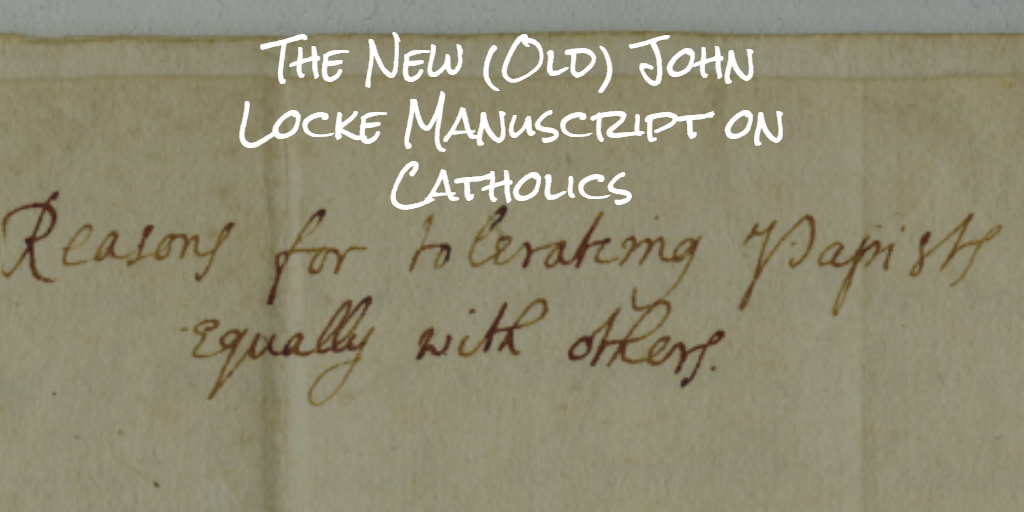
Reasons for Tolerating Papists Equally with Others I read about it in the Guardian yesterday, and my cousin at St. John’s found the digital copy right there on the internet in plain sight. Apparently no one had attempted to transcribe it yet? It’s a confusing document–looks like reading notes from some separate document, as there…
Today I am testifying on behalf of the Second Look Amendment Act of 2019, sometimes dubbed IRAA 3.0. The initial IRAA, the Incarceration Amendment Act, was designed to provide post-sentencing review to those who committed crimes as juveniles and were given life or near-life sentences. IRAA 2.0 extended eligibility and clarified some issues in the…
Entrepreneurship is a particular approach to citizenship. It’s about trying to find new ways of being of use to each other. Formerly incarcerated people are increasingly marginalized in our society–but they deserve to be treated as valuable and with dignity.
“So successful has the prison been that, after a century and a half of ‘failures’, the prison still exists, producing the same results, and there is the greatest reluctance to dispense with it.” Foucault, Discipline and Punish, 277 In my mini-review of Bryan Caplan’s polemic against education, I noted that he partly ignores Foucaultian arguments for…
Progressives are coming around to the idea that higher education is not a great leveler, and the segregated K-12 schools are increasingly a pipeline to prison rather than jobs for the least advantaged.
Lexington Press has recently finished publishing a four volume collection of the work of Elinor Ostrom and her husband Vincent–before that I do not believe the work has been gathered anyplace easily accessible. Since the price is astronomical–though well worth it for the serious scholar or scholarly library, I’m sure–I’d love to have a single-volume reader…
Today is the first day of classes in my seventeenth year of teaching. I have taught a lot over those years–sometimes as much as a 5/5/1 (5 courses in Fall, 5 in Spring, and one over the summer.) My sense from that time is that the value of a philosophy course is largely not derived…
Thomas Edsall has a good review of some recent research on polarization in the New York Times today: The strength of a voter’s identity as a Democrat or Republican drives political engagement more than personal gain. Better educated voters more readily form “identity centric” political commitments to their party of choice, which goes a long…
James Forman, Jr. won the Pulitzer Prize last week for his book Locking Up Our Own. It is well-deserved. That book– and his earlier work wrangling with Michelle Alexander’s The New Jim Crow –shows the ways that we have arrived at the wicked problem of mass incarceration through something much harder to disdain than evil scheming…
(Sometimes you wake up in the middle of the night with a reading of the political economy of Moana, and you just have to write it down. I regret nothing!)
I’m in Dallas, Texas for the the National Conference for Higher Education in Prison. Today I’ll be presenting a paper from a larger project on loyalty and social science research methods which draws on an argument I first encountered in Peter Levine’s work . Here’s a link to the PowerPoint of my talk. It is…
What is the connection between hylozoism, atheism, and egalitarianism? Kojin Karatani suggests an answer, and I wrangle with the New Atheists along the way.
(This post is part of a roundrobin reading group on Kojin Karatani’s Isonomia and the Origins of Philosophy. I focus here on chapter one; James Stanescu previously discussed the preface and appendix, and Joseph Trullinger will be discussing chapter two in the next few days.) In a certain sense, much of Karatani’s book is a…
Hannah Arendt never wrote a “moral philosophy.” It is not hidden away in the archives or any of the recent collections of her work, nor in her unpublished lectures, letters, or journals. She was a political theorist who thought that moral philosophy requires a set of social relations that are inaccessible in the modern world. Yet as she has become more popular and is taught more and more often by moral philosophers, she is developing an unearned reputation as a moralist that perverts both what we should mean by moral philosophy and what she hoped to show us about the world we now inhabit.
I know it’s become standard fare for liberals to criticize Republicans for injustice. But I want to take a strong stand against this disgusting display, in which the Governor of Ohio, acting as a public official, told the world: “We want all the immigrants to come to Ohio, because we know how much they contribute…
This piece was co-written and co-published with Eric Schliesser. The most dazzling example of co-authorship is Paul Erdős, who co-wrote more than 1400 papers in mathematics with 485 collaborators. ( What is your Erdős number ?) To do this, he became functionally homeless: “ His modus operandi was to show up on the doorstep of…
It’s France’s fête nationale– Bastille Day–marking the storming of the Bastille Saint-Antoine. The crowd of revolutionaries were mostly looking for guns and ammunition held by the garrison of soldiers stationed there, but they also suspected that the prisoners were being tortured. (They weren’t.) Seven prisoners were freed that day: four forgers, two mentally-ill people, and…
This is a part of a series on terms and concepts that I find particularly resonant. We usually say that the fundamental rule of economics is scarcity : there are never enough widgets (food, housing, gadgets) to meet all the demand And even where we seem to be endowed with wealth, we still face opportunity…
My friend David O’Hara writes on Facebook: On certain days of the year I return to readings of civic importance that suit that day. It’s a political parallel to the liturgical calendar, I suppose. So on Independence Day (July 4) I read the Declaration of Independence; on MLK Day (third Monday of January) I read…
Last year during the conference we received news that Great Britain had voted to leave the European Union: this year the conference began with a preconference on authoritarianism.
I love Peter Levine’s latest post, “don’t let the behavioral revolution make you fatalistic.” “Tversky’s and Kahneman’s revolutionary program spread across the behavioral sciences and constantly reveals new biases that are predictable enough to bear their own names. […] These phenomena are held to be deeply rooted in the cognitive limitations of human beings as creatures who evolved…
College in prisons is the easiest and most obvious of a host of criminal justice reforms that we absolutely must be making and for which there is bipartisan support. We incarcerate 2.3 million people in the US, at a rate more than seven times higher than the global average. We’re not seven times more violent or larcenous than the rest of the world–perhaps we are seven times more racist, but even that isn’t clear any longer–so we need to fix this over-incarceration crisis. But for the time being, educating the people we incarcerate is almost literally the least we can do.
We often say that colleges and universities deserve some sort of freedom from political interference. But for Arendt, freedom just is politics. The idea of freedom from politics is largely oxymoronic for her, and involves fundamental misunderstandings of the component terms “freedom” and “politics.”
This past weekend, we inaugurated a new competition soliciting “civic games.” Hopefully it will become an annual contest, but for now the most vexing question coming from game designers is: “What makes a game civic?” Our definition of civics offers little help: we argue that civics is an expansive conception of politics, understood as a…
More than anything else, the current political climate shifts the kinds of solutions for which our fellow citizens will reach. Rather than hoping to make change at the national level, we must organize our political lives around more local efforts. Rather than seeking assistance from state institutions we must organize and act ourselves. I have seen four specific projects suggested that I’d like to endorse.
“To what purpose then require the co-operation of the Senate? I answer, that the necessity of their concurrence would have a powerful, though, in general, a silent operation. It would be an excellent check upon a spirit of favoritism in the President, and would tend greatly to prevent the appointment of unfit characters from State…
Hanukology : It was basically an argument between two points of view that mixed abstractions and interests (as always), but (also as always) with variations and fluctuations, mind-changes and occasional betrayals. To simplify somewhat, one side, those who later (in Hasmonean times, see below) became known as Saducees, were religious conservatives but pro-Hellenist cultural liberals;…
Let those with enough time to consume all the media in a field decide on the objective bests-of-2016. What follows is a completely subjective list of bests, idiosyncratically limited by what I’ve actually had time to watch, read, or listen to: Best New Book in Philosophy: We don’t think hard enough about the metaphysics that…
Long before white Americans felt like their society had abandoned them, Black Americans knew the feeling. Just like whites do today, some Black Americans responded to earlier superfluousness by ” clinging to guns and religion ” to use Barack Obama’s famous analysis. (cf. Kinsley gaffe ) Here’s James Baldwin, describing the Nation of Islam: “I’ve…
I have lots of feels and lots of arguments about these two pieces by Peter Levine on an alt-left populism: “pluralist populism” and “separating populism from anti-intellectualism.” (This post on identity politics is also relevant.) Peter even goes so far as to call himself a populist, which is a surprising move to restore the term’s…
In my last post before the election, I quibbled with Peter Levine’s strategic argument that Trump’s supporters might be momentarily richer than average, but only because they were older, maler, and whiter. I worried that it was a kind of mistake, even if it’s perhaps an analytic effort designed to enhance our ability and willingness to achieve…
Corey Robin got some nice jabs in at the current class of younger non-academic pundits a while back : A lot of these pundits and reporters are younger, part of the Vox generation of journalism. Unlike the older generation of journalists, whose calling card was that they know how to pick up a phone and track down…
Today I’ll be addressing a group of imprisoned students, university administrators, and prison officials to inaugurate the University of Baltimore’s partnership with the US Department of Education and Jessup Correctional Institution to offer Bachelor’s Degrees. We have a few tasks today, including inspiring the students and encouraging the officials that their support for the program…
This post is a part of a series on some ideas that I find particularly useful or interesting. It also extends the post from last week of metaphysical deflation in Nietzsche. Here, I begin an account of Arendt’s metaphysical deflation, and its intimate connection to a kind of skepticism about personal identity. Though Hannah Arendt began…
What, then, is truth? A mobile army of metaphors, metonyms, and anthropomorphisms—in short, a sum of human relations which have been enhanced, transposed, and embellished poetically and rhetorically, and which after long use seem firm, canonical, and obligatory to a people: truths are illusions about which one has forgotten that this is what they are;…
I find the distinction between psychological disorders and personality disorders fascinating. Consider obsession and compulsion. Someone suffering from the anxiety disorder OCD will often engage in ritualistic actions: locking and unlocking a door a set number of times, carefully arranging furniture, repetitive washing, or hoarding. A person with the personality disorder OCPD may do some…
“Older than the superfluous wealth was another by-product of capitalist production: the human debris of every crisis, following invariably upon each period of industrial growth, eliminated permanently from producing society. Men who had become permanently idle were as superfluous to the community as the owners of superfluous wealth.
In patriarchal cultures, women and men are required by the political economy to form family units for institutional purposes. This is very difficult on individuals when the sex ratio deviates from parity. Sometimes small communities experience this sex ratio deviance due to economic migrations, where men or women move abroad to find work, but are…
Consider the collective horror, shame, and disgust we philosophers have at the abusive behavior of our fellow philosophers: think of what it means to be compared to Colin McGinn or Thomas Pogge. Why isn’t there that kind of horror, shame, and disgust among police officers at the drumbeat of police shootings?
In a post today , my longtime friend Leigh Johnson charges me with erasing her contribution and appropriating her idea of “friendly fire” in my response to Noma Arplay and Joseph Trullinger. In this post, I want to acknowledge my error and say a few things about the difference between our two conceptions of “friendly…
Too often in praise for “agonism” we tend to treat the conflicts as if they are self-justifying. Trullinger’s view is that we ought to endorse the spirit of “glad to be wrong” by being particularly welcoming to those who are unlike us, those who are most likely to find the space of rough play unwelcoming, those with whom we truly lack homonoia. True strangers are those who can offer us grounds for disagreement much stranger than mere contradiction.
To be clear, I’m not endorsing drug markets, or even beating up your food truck competitors. But I find it strange when ordinary human behavior–often the laudatory kind that is responding to a larger abuse of power with small-scale violence–is pathologized by my fellow liberals who recognize the small-scale violence but ignore the larger abuses.
When civic studies scholars write about civics and citizens, as Peter Levine does today , we will usually mention the following trinity: facts, values, and strategies. Here’s Levine: The citizen is committed to affecting the world. Some important phenomena may be beyond her grasp, so that she sees them but sees no way of changing them….
As the political participation of disaffected, unrepresented voters drops, this reserve army of the unallied gets bigger. It’s especially potent in primaries, which are very low turnout events. My suspicion is that if disaffected voters could be reliably re-engaged, the parties would likely find wedge issues to divvy them up over a relatively short set of elections. But they may well divvy them up differently than the parties had previously done. This would be the seed of a realignment.
There’s an interesting piece in the Stone today on the consequences of philosophy’s Anglo-European blinders: If Philosophy Won’t Diversify, Let’s Call It What It Really Is . Garfield and Van Norden suggest that the systematic failure to address non-Western sources impoverishes the discipline and belies any claim to universality. And what a wonderfully provocative list…
Whenever I teach an advanced class of thoughtful students, I like to offer a short retrospective at the end of the semester. I sit down without my notes or texts and try to makes sense of what we have done. Below, you’ll find the retrospective I shared on our last day. (As background, we read…
What should schools do about the fact that politicians are frequently both wrong and immoral in ways that violate educational norms? How can civics education be civil if civic engagement rarely is?
Thomas seems to me to be saying that as a matter of policy we should remember that we live in a white supremacist society, that Blacks are in the minority and the political institutions will usually be controlled by white politicians and white voters. So always be careful of the tools and remedies you make available to those white racists, because they’ll use the rubric of the white man’s burden to justify all sorts of evils. They’ll use well-meaning liberals as the tip of the spear, like colonial powers used missionaries or US neo-imperialism uses the Peace Corps.
On a lot of the activist issues I worked on it was very important that we get no press. And I think, from the outside, one of the things people assume about activism is that you’re trying to consciousness-raise around an issue, and get public discussion and raise public awareness and raise the profile of an issue–not if you’re talking about the comfort of death row prisoners. You don’t actually want that subjected to a popular referendum, because that’s going to be a kneejerk, regressive response.
I’ve been an Auden fan probably since I first heard his mourning poem in 4 Weddings and a Funeral. ( Recall my doggerel .) That he corresponded with Arendt mattered a great deal to my dissertation work; I also quite like the thematic connections between his ” The Unknown Citizen ” and another favorite poem, “…
I started out to write a neoliberal theo-politics; rough and ready and trying to show where matters of relatively unchallenged beliefs about the world have led me. Challenges and data now force me to revise those beliefs. What could be more neoliberal and technocratic than that?
The standard response to the problem of evil is that evil is the result of human willing: thus the Holocaust or American racism cannot be laid at the feet of an omniscient, omnipotent, and perfectly benevolent God. But I think this seriously ignores the problem of natural evil.
The fantasies of social death are pernicious precisely because they imagine no return. The reality is that most of these men must someday rejoin the communities from which they have been exiled. People come back. What’s more, they’re never really that far away.
Many of my own fellow-travelers police progressivism in a way I sometimes find frustrating. It is de rigeur to chastise neoliberals and technocratic moderates for their lack of radicality. My work tends towards the technocratic/participatory divide around how policies should be made, and so I often don’t have strong policy preferences unless I’ve researched a…
It is pretty clear to me that there ought to be some kind of right to photograph and film police, especially arrests. And yet, at least one US District Judge Finds no First Amendment Right to Film or Photograph Police : We find there is no First Amendment right under our governing law to observe…
I have written here repeatedly about the problems with person-oriented reactive attitudes and character skepticism. But recently I came across the work of the psychologist Albert Ellis , whose work is at the intersection of therapeutic psychology and philosophy. His work on self-esteem and person-oriented assessment suggests an interesting new direction for the general insight…
Susan Brison’s Aftermath ends twice: the final chapter discusses her various efforts to retell the story of her brutal rape and attempted murder (she calls it “attempted sexual murder.”) And ends with her final, planned retelling to her son when he is older: “Tragedy,” Wittgenstein wrote, “is when the tree, instead of bending, breaks.” What…
Even mildly deliberative moments like the Iowa caucuses can lead to surprising outcomes because a very different public (no longer hypothetical) is constituted by the caucus form.
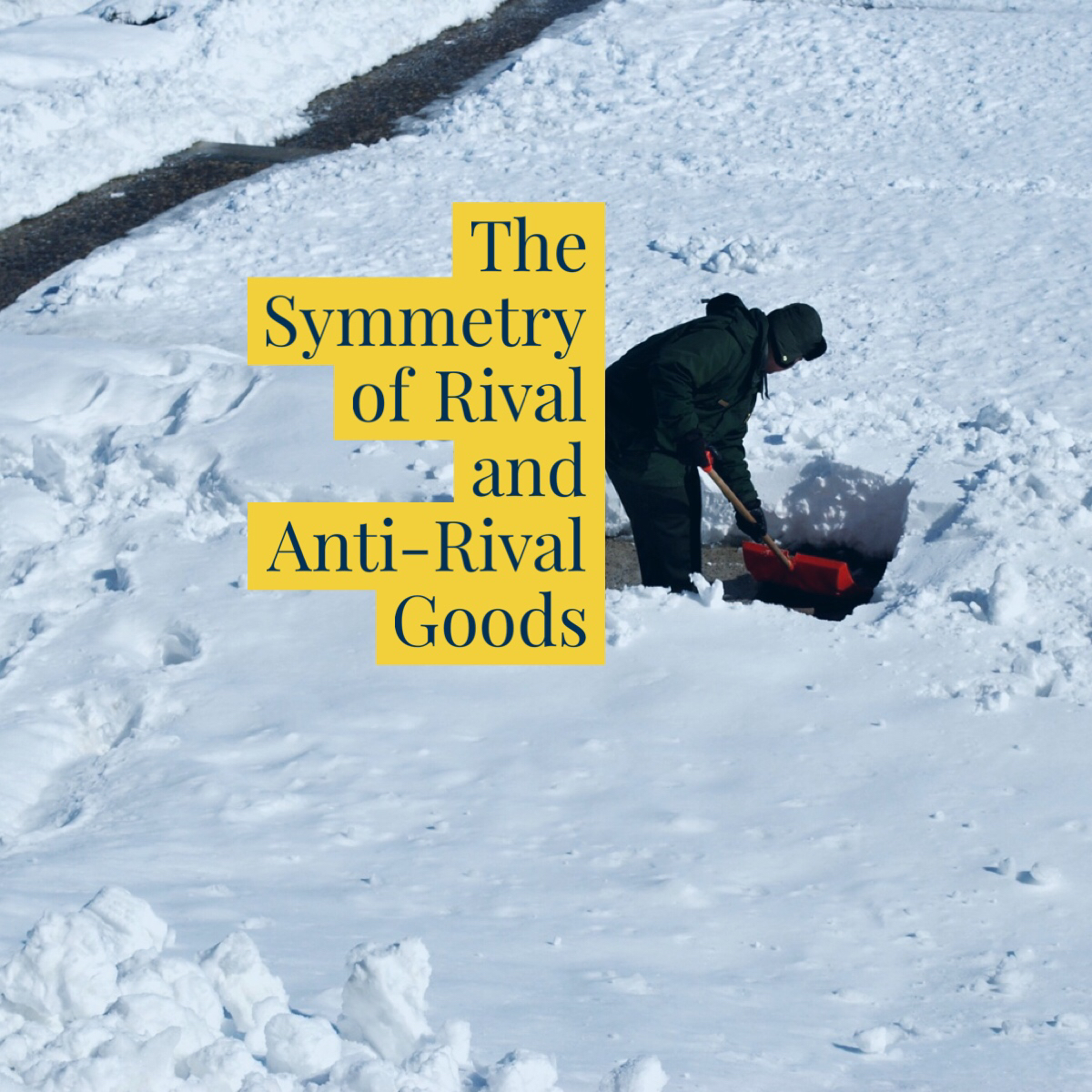
A shoveled sidewalk is a strange sort of common pool resource: it’s not like fisheries or irrigation where the more one person uses the resource, the less there is for others. That is, it’s not precisely “rivalrous,” one of two conditions required for a common-pool resource to flourish. In fact, the more people shovel their sidewalks, the better off each individual with a shoveled sidewalk is. This is what economists call “anti-rivalry” and is frequently linked to network effects.
I’ve been thinking a lot about the new evidence that partisan distrust and even hatred now trumps racial hatred. Consider the now-famous Iyengar/Westwood study, ” Fear and Loathing across Party Lines: New Evidence on Group Polarization .” Iyengar and Westwood showed that partisan identification has ceased to be a wholly ideological or instrumental self-description. It’s…
This is the direction I wish philosophy was headed, making sense of the problems at the intersection of our lives, our political economy, and our self-deception.
I do think those are basically the right judgments about fossil fuels: they are awesome, we should be glad that they existed, and it really sucks that we’re going to be giving them up, but it’s time to take action. That said, it’s not clear why I can’t also feel: Anger that providence does not supply as good a solution without the costs. Resentment that those who have profited from fossil fuel extraction are willfully denying the evidence that we must change. Frustration that scientific consensus does not bind more of my fellow citizens and their elected representatives. Suspicion of the ways that our current interests cause us to downplay the risks and need for resignation and determination. Those seem perfectly rational to me, too. And we might not be able to hold all those emotions in our mind at the same time, and thus we find that we’re unable to capture the state of perfectly neutral ambivalence that Caplan here suggests is a prerequisite for being considered rational.
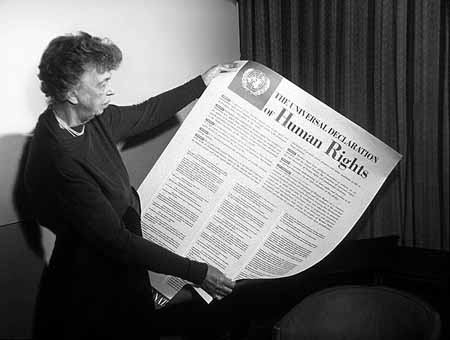
On my view, human rights aren’t political conversation stoppers, they’re a prerequisite for certain kinds of political conversations at all. Indeed, human rights are so foundational to certain kinds of political conversations that many people lay claim to them even where they don’t exist so as to begin or continue a difficult political conversation.
I have a two year old daughter, and I’m overwhelmed every time this happens with fear and anger. I teach at a university, and I feel special fear every time there is an active shooter reported, though I quickly cover it with bravado and statistical arguments. (There were two on my old campus in a…
“It is indeed my opinion now that evil is never ‘radical’, that it is only extreme, and that it possesses neither depth nor any demonic dimension. It can overgrow and lay waste the whole world precisely because it spreads like a fungus on the surface. It is ‘thought-defying,’ as I said, because thought tries to…
“Yes, you assistant professor, of all the loathsome inhumans the most loathsome….” “A ludicrous sullenness and paragraph-pomposity that give an assistant professor a remarkable likeness to a Holberg bookkeeper are called earnestness by assistant professors….” “When an assistant professor, every time his coattails reminds him to say something, says de omnibus dubitandum est [everything must…
Fuck Nuance (Abstract: Seriously, fuck it.) Raising Children Without Religion May Be A Better Alternative, Suggests New Research. (One of the underlying studies suggests that “religious humanitarianism is largely expressed to in-group members” because “a strong religious in-group identity was associated with derogation of racial out-groups.”) The Green Street Project is a nice interactive thingie that gives you…
Estimating the reproducibility of psychological science: “Thirty-six percent of replications had significant results….” Swing Voter #BlackLivesMatter protests Mayor Bowser’s new policing policies. See also: Peter Levine on #BlackLivesMatter and Hillary Clinton. Visualizing Economic Complexity Interview with Matt Damon on The Martian.
Nathan Smith: “American egalitarianism is a sheltered creed that needs the border as blindfold to retain its limited plausibility as an ideal.” Literary Magazines for Socialists funded by the CIA, ranked (Partisan Review is #3) Pope Francis to visit a Pennsylania prison and call for reform in Congress. Michael Rosen: I sometimes fear that people might…
Intuition can encourage opinions that are contrary to the facts. Press the space bar to load a new puppy. Antonia Malchik: Over the past 80 years, walking simply as a way to get somewhere, let alone for pleasure, has become such an alien concept to Americans that small movements towards making neighbourhoods and communities more…
Social Perfectionism and Why Suicide Unfairly Impacts Men Science isn’t Broken: It’s just a hell of a lot harder than we give it credit for “millions of lives may be about to change profoundly” The Chronicles of Prydain is the greatest fantasy series ever written Alternatives to Beats by Dre at every price point and…
Happiness studies say parenthood is bad for you. Probably this tells us more about happiness studies than happiness. Lisa Feldman Barrett: What Emotions Are (and Aren’t) Five Philosophy Books for Children Emily Oster: Everybody Calm Down about Breastfeeding (But see also) “Knowing whom to ask and also how to ask is also often more valuable than a detailed knowledge…
[caption id=”” align=”aligncenter” width=”373″] This happens a lot in philosophy.[/caption] Update: As Scu points out, sharing this opens me up to the scrollover text (which doesn’t show on hotlink): “‘But you’re using that same tactic to try to feel superior to me, too!’ ‘Sorry, that accusation expires after one use per conversation.’”
While to many people the reformer and the abolitionist are indistinguishably radical, there is a disheartening tendency for reformers and abolitionists to fight rhetorical battles about the strategies and ends of the movement. Thus we are riven by rhetoric. To the abolitionist, this is because reform tends to reassert the status quo after superficial changes: the risks of complicity are real. To the reformer, though, this is unfortunate, because we could be more effective in solidarity.
Everyone always learns the wrong lesson from the Stanford Prison Experiment and the Milgram Shock Study: we always think it means that other people are horrible. We ignore the possibility that we might be horrible, too, given the right circumstances.
The Donatists judged that reunion with the Catholics would entail a new domination by the crumbling Roman Empire. They refused to forgive, refused to share authority and a political world with Roman agents who claimed to want only peace but had historically engaged in political domination in the region. The question that Augustine’s letters present is this: could they forgo ‘sharing authority’ while preserving the charitable affect of dwelling in a shared world? Generally speaking charity does not demand agreement or the fusion of horizons, certainly not in the face of an unforgiveable scandal.
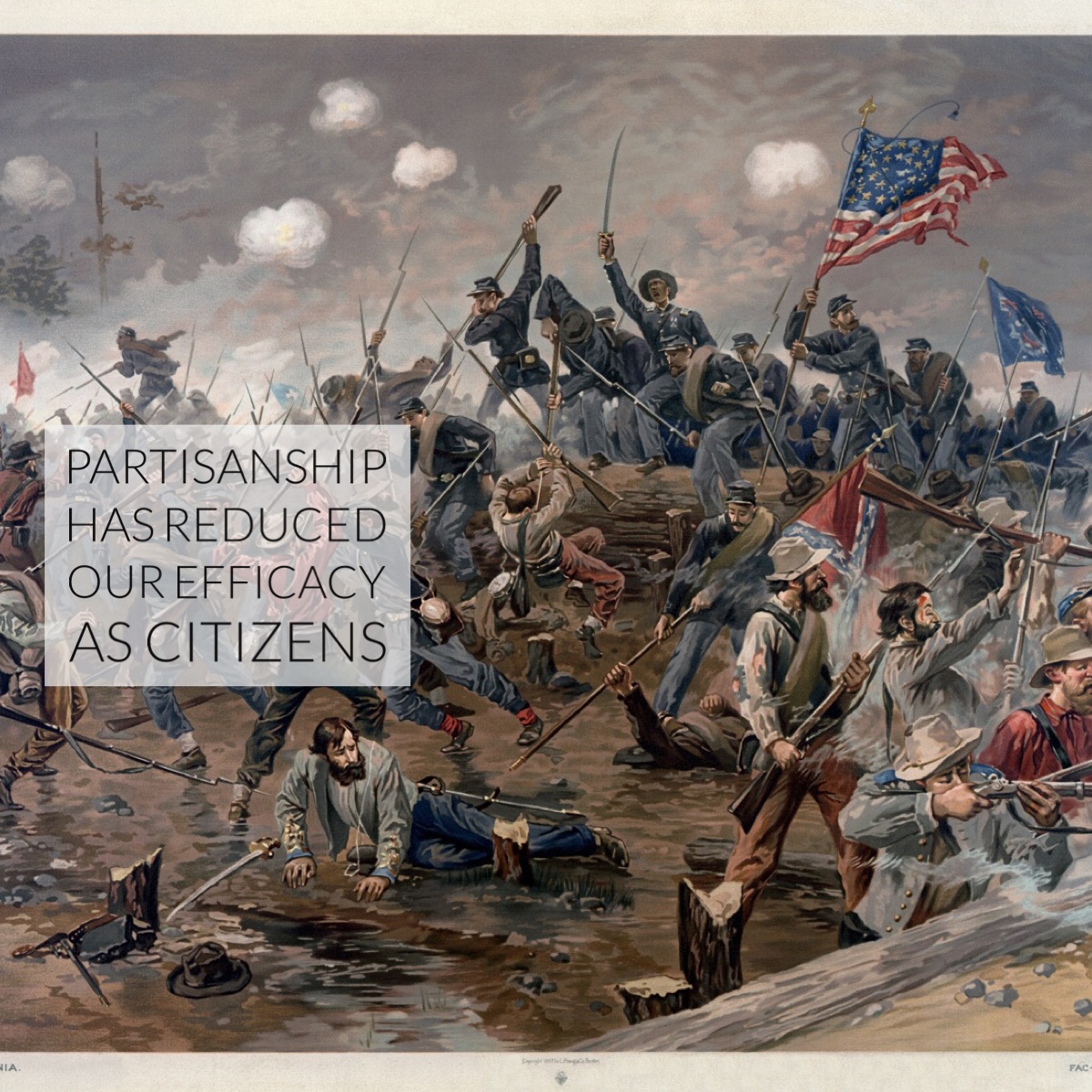
No matter how much we might disagree about one law or policy, that disagreement should not be allowed to destroy the possibility of a future alliance on a different problem. Citizens tempted by partisanship have to find a way to hold their ideas and convictions loosely. They have to preserve civic friendship and reject permanent divisions.
A citizens movement doesn’t have to be leaderless, but the kinds of leaders ensconced at the top of large institutions are not well-suited to be the leaders of civic renewal movements. They can inspire and celebrate such movements, but neither Barack Obama nor Bernie Sanders nor Pope Francis can lead them. Their institutional authority appears to be inimical to the very bottom-up power they’re trying to engender.
As I see it, the limit of forgiveness is not within our voluntary power, an act of will, but rather in developing the capacity to imagine the act that we are trying to forgive. Thus the skandalon of forgiveness is an imaginative challenge, we stumble over it when acts are unimaginable, and we overleap it when our imagination succeeds. We make these imagined acts meaningful for others through poiesis: we create a world of meaning in which they are imaginable by marking exemplars, noting commonalities, and creating spaces of remembrance. The product of our work thus makes these meaningless deaths and thought-defying atrocities meaningful and thinkable. If you think about it from the perspective of un-consolable resentment, this is a crime akin to justification or exoneration.
Modernity of our sort produces a certain kind of despair and helplessness because the primary sources of hope are technological development and the institutional efforts of technocrats. The best hope of progress is always elsewhere: the Supreme Court, Silicon Valley, the Justice Department. Looking back we see lots of progress but no role for ourselves in achieving more.
After the families of the victims of the Emanuel AME church shooting unilaterally forgave the shooter , I’ve been thinking again about forgiveness. (Some previous posts here .) In particular, I am wondering again about the relationship between theological and political forgiveness. The classic Enlightenment description of the duty to forgive is derived from the…
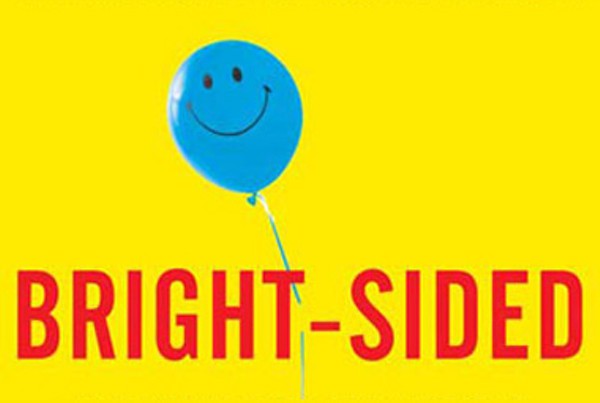
Barbara Ehrenriech’s book Bright-sided starts with an interesting dilemma in breast cancer treatment. On the one hand, your odds of surviving–say–stage 4 breast cancer is quite low (22%). On the other hand, there is evidence that optimism and hopefulness will increase your chances. Being optimistic won’t increase your chances above 50%, but it will help….
The New York Times has a story on the new CCRB report that includes data on the rise of proveable police deception: In New York, the number of false statements noted by the agency, while small, has grown in an age of easy and widespread video and audio recording by civilians. In 2014, the agency found…
One of the reasons I blog less than I used to is that in addition to running this journal I’ve been teaching and organizing a college program at Jessup Correctional Institution . (Although I think it was having a daughter that really sucked the wind out of my sails, blogging-wise.) Anyway, to prove I haven’t…
I’m not a libertarian, but some of my good friends are and I tend to think that there are lots of really promising areas of agreement with libertarians. The blog Bleeding Heart Libertarians was founded with just that goal in mind: to find the points of agreement between libertarian and progressive goals, and indeed (in…
What is meaning in life? A couple weeks ago we had a visit from David Benatar, who kindly shared a chapter from the new book he was writing. The chapter he shared was on meaning in life, and it was–as much standard analytic philosophy is–pretty narrowly focused on making distinctions and arguing against various perspectives….
A couple of years back Tim Scanlon did a blog post and comment-section discussion on PEA Soup . Here’s one bit: In earlier work, including my Tanner Lectures on the significance of choice and Chapter 6 of What We Owe to Each Other, I rejected the idea of moral desert because I identified it with…
The profile of Judith Clark from last month has me worried: We are more willing to impose death when the killer is painted in monochrome—if we can define him or her by the horror of the crime. Many think this is just; that is what blame and punishment are about. But in rare public comments…
Is the problem that philosophers and folks in the humanities think that genius exists, and it doesn’t? Or is the problem that philosophers and folks in the humanities think that they can detect genius, and–because of their racism and sexism–they can’t?
Futures Thinking: The Basics Asking The Question Scanning the World Mapping Possibilities (Part 1, Part 2) Writing Scenarios Three Possible Economic Scenarios (Part 1, Part 2) A Bibliography
[caption id=”attachment_4477″ align=”alignright” width=”300″] A crying baby, but not *my* crying baby from Flickr user donnieray (CC By 2.0)[/caption] My daughter doesn’t like to have her teeth brushed. She’s not even two years old, yet, so while that worries me, I guess it’s something we’ve still got time to correct. But one question I often…
Replication-gate continues, this time with a successful replication of Arthur Aron’s interpersonal closeness study : To Fall In Love With Anyone, Do This. The odd thing is that the author tried it, found it caused feelings of intimacy with a potential sexual partner, and now calls that love. Because Aron’s whole point was that our…
We’re about to find out what would happen if policing decreased by 66%-94% : It’s not a slowdown — it’s a virtual work stoppage. NYPD traffic tickets and summonses for minor offenses have dropped off by a staggering 94 percent following the execution of two cops — as officers feel betrayed by the mayor and…
In preparation for our own series on militaries in The Good Society , I’m reading this very interesting series from the Military Times: AMERICA’S MILITARY A force adrift Readiness ‘on a shoestring’ The crushing deployment tempo Were the wars worth the cost? A conservative institution’s uneasy cultural evolution It’s worth checking out.
Charles Koch is committed to reforming the criminal justice system : “We are not a nation of bad people. We are a nation that made some bad choices,” he said. “We’ve become addicted to severe sentences, to the point where we are mass-producing convictions in many courts, while not providing defense counsel on a timely…
Eric Schwitzgebel does the math, interprets the lessons: (This past Hannukah, my daughter Kate and I spun a sample of dreidels 40 times each. One in particular landed on shin an incredible 27/40 spins. [Yes, p < .001, highly significant, even with a Bonferroni correction.]) [….] You can, if you want, always push things to…
Shawn Gude at Jacobin discusses The Bad Kind of Unionism : “It’s easy to focus on the individual over the institution. Not a few police officers are drawn to the profession out of a desire to “serve the public.” Many genuinely want to serve, and take great pride in their chosen occupation. Police don’t have…
Insofar as we are engaged in a collective project, we must both mutually support each others’ inquiry and avoid errors. These two goals are at odds: homogeneity can also lead to unchallenged motivated reasoning and thus to polarization and error. But mutual inquiry requires some degree of shared values, assumptions, and methods which make political diversity divisive and paralyzing.
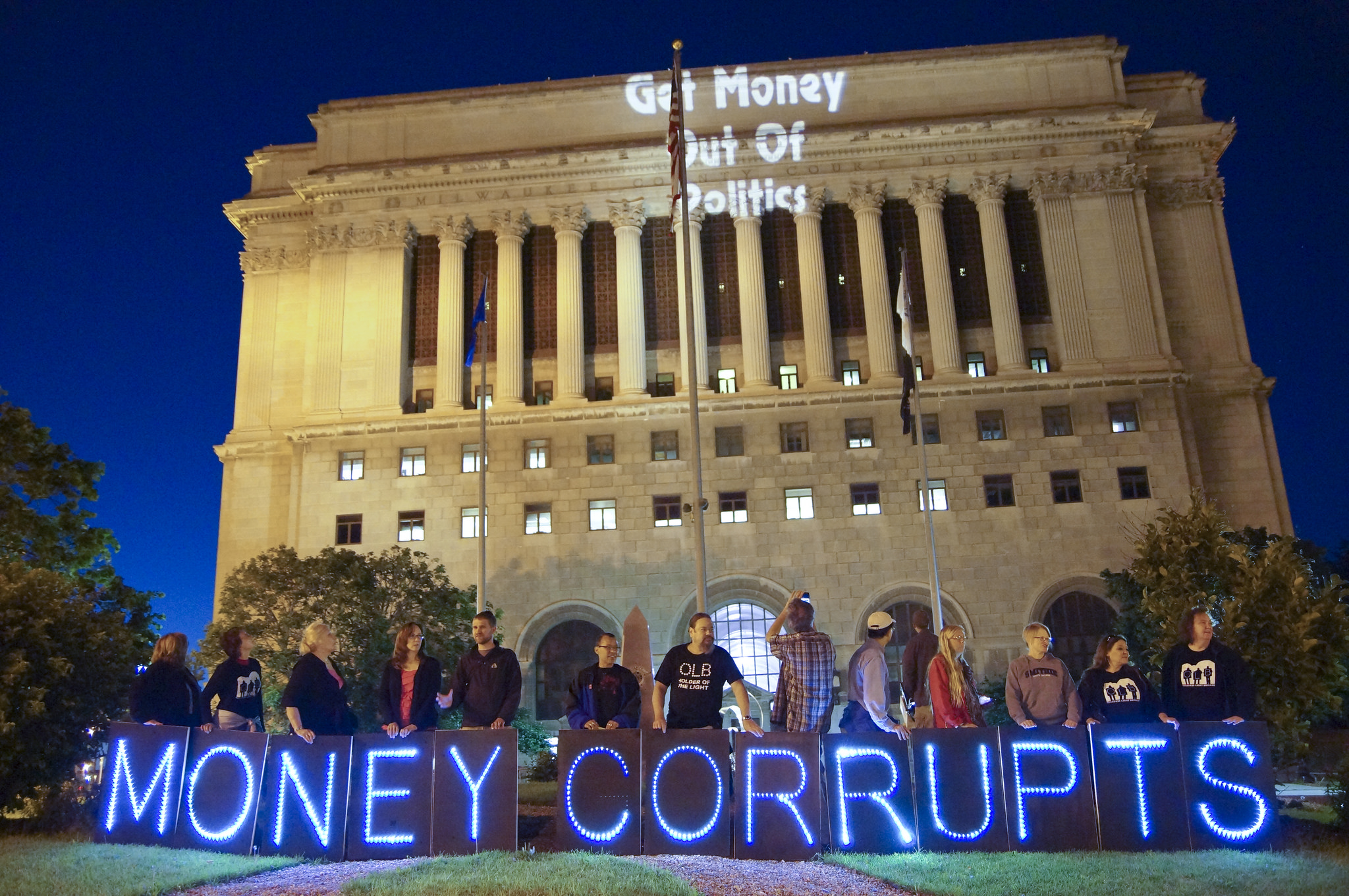
[caption id=”attachment_4024″ align=”alignright” width=”300″] “Get Money Out of Politics” by Flickr user Light Brigading[/caption] Some things live forever in social media. In my circles, one article that comes up all the time is the Gilens and Page study of legislative influence that is often interpreted this way: ” US No Longer an Actual Democracy “…
I’ve been thinking a lot about how the middle-class exercise school choice through real estate decisions, and what that does to the fabric of our cities. Recently I came across a dissertation by Jennifer Burns Stillman that has some interesting references. Here, for instance, she addresses Barbara Ehrenreich’s account of the middle-class mentality . Much…
There has been much discussion lately about the ranking of graduate programs in philosophy: Ed Kazarian writes ” Maybe the Best Rankings are No Rankings at All ,” and Eric Schliesser replies with ” Yes, but, we do need rankings .”Noelle McAfee suggests a search engine that allows prospective students and administrators to create their…
Recently I’ve been thinking about a book by Erin McKenna which I read as an undergraduate: The Task of Utopia: A Pragmatist and Feminist Perspective . I read it then because it promised to bridge the divide between my favorite genre, science-fiction, and my interest in philosophy. But the book profoundly changed me, and I’m…
A couple of weeks ago, I joined with hundreds of other students and scholars at Johns Hopkins for a conference on prisons and the social determinants of health . The star of the conference was this story: One day three men were fishing in the river when they noticed a baby floating towards them. Two of the men…
My old friend Leigh Johnson has a piece cowritten with Ed Karazian up today at New APPS on tone and civility in philosophy . I’ve already had some things to say in the comments there, but I haven’t done a good job of responding to the substance of what they wrote, so I wanted to…
Wonkblog does a roundup: “Whoever it is that keeps insisting their preferred policies are panaceas has a lot of explaining to do.” No mention of civic engagement, the basic income guarantee or prison abolition, so I guess they’re still in the running.
[caption id=”attachment_3215″ align=”alignright” width=”224″] by flickr user ChrisM70[/caption] I’ve just finished an article on higher education and the liberal arts, and it’s full of hope and comes to some definite conclusions about particular ways that an education in the liberal arts is valuable. It’s out for peer review right now, which means that if the…
It looks like I’ll be co-teaching a course on violence with Daniel Levine in the spring, and I have some questions: Is it just me, or do philosophers rarely talk about violence? We talk a lot about killing, and war, and punishment, and even torture. We talk about peace and non-violence. But “violence” doesn’t come…
I generally hate the hyper-patriotic memorialization of this day, as I’d prefer to forget. But today saw many on social media sharing their stories, so I thought I’d share mine, too. I was in the subway, headed to work at the Civilian Complaint Review Board a couple blocks south of the towers , in the…
I can think of at least six kinds of inequality: [caption id=”attachment_3117″ align=”alignright” width=”300″] Hefei, Anhui province in China (Photo by Jianan Lu.)[/caption] Inequality of income: different people receive different wages, either for different jobs or for the same job, as profits from capital investments, or as government subsidies, transfer payments, or private charity. Inequality…
[caption id=”attachment_3097″ align=”alignright” width=”201″] “A Hindu Woman Giving Alms,” by Raja Ravi Varma[/caption] Daniel Levine has an interesting discussion of giving and giving well up today on whyiamwrongabouteverything : When I got a “real” job at USIP, back in 2007, I resolved that I was going to donate 10 percent of the portion of my…
Well, he’s not. But that’s the title of his new blog . (Apparently he is challenging me for the title of “Most Contrite Fallibilist.” He’s even taken the nom de plume of “Wrongzo.” Bastard .) For his first substantive post, ” What should we mock about when we mock about guns? ” he parodies my…
I love policy discussions, but the demands for policy discussion on gun control after the shootings in Newtown today are terribly wrong-headed. The problem is that demanding a policy discussion is not the same thing as having a policy discussion. At this point, we’re just talking about talking about gun control. It’s all “mention” and…
Keith Humphreys shares this interview with Vanda Felbab-Brown . There are no dull moments, but here’s one I think should give us lefties pause: what will replace the underground marijuana economy? Felbab-Brown explains: Most of the time governments tend to fight illicit economies and not think about what will replace them. Policies are often premised…
Some recent posts by Dan Kahan on the subject of “cultural cognition” deserve attention: (Cultural cognition refers to the tendency of individuals to conform their beliefs about disputed matters of fact (e.g., whether global warming is a serious threat; whether the death penalty deters murder; whether gun control makes society more safe or less) to…
[caption id=”attachment_3023″ align=”aligncenter” width=”300″] Old Ohio Penitentiary by J. Harris Day[/caption] This semester I taught a course on crime and punishment, and in part out of competition with my colleague Seth Vannatta , I set out to give a final presentation on the dimensions of the course. This is the presentation I wrote. Introduction…
[caption id=”attachment_3029″ align=”aligncenter” width=”300″] by Seany2000[/caption] Via Metafilter’s kliuless (who definitely has a kliu): The Conservative War on Prisons: “Right-wing operatives have decided that prisons are a lot like schools: hugely expensive, inefficient, and in need of root-and-branch reform. Is this how progress will happen in a hyper-polarized world?” Raise The Crime Rate: “Statistics are…
Here’s a bet I’d like to make: a good introduction to philosophy course will do more to increase students’ critical thinking abilities than a good course in logic or critical thinking. Here’s what I think I’d need to get this bet off the ground: First, we’d need a stable student body and a randomly selected…
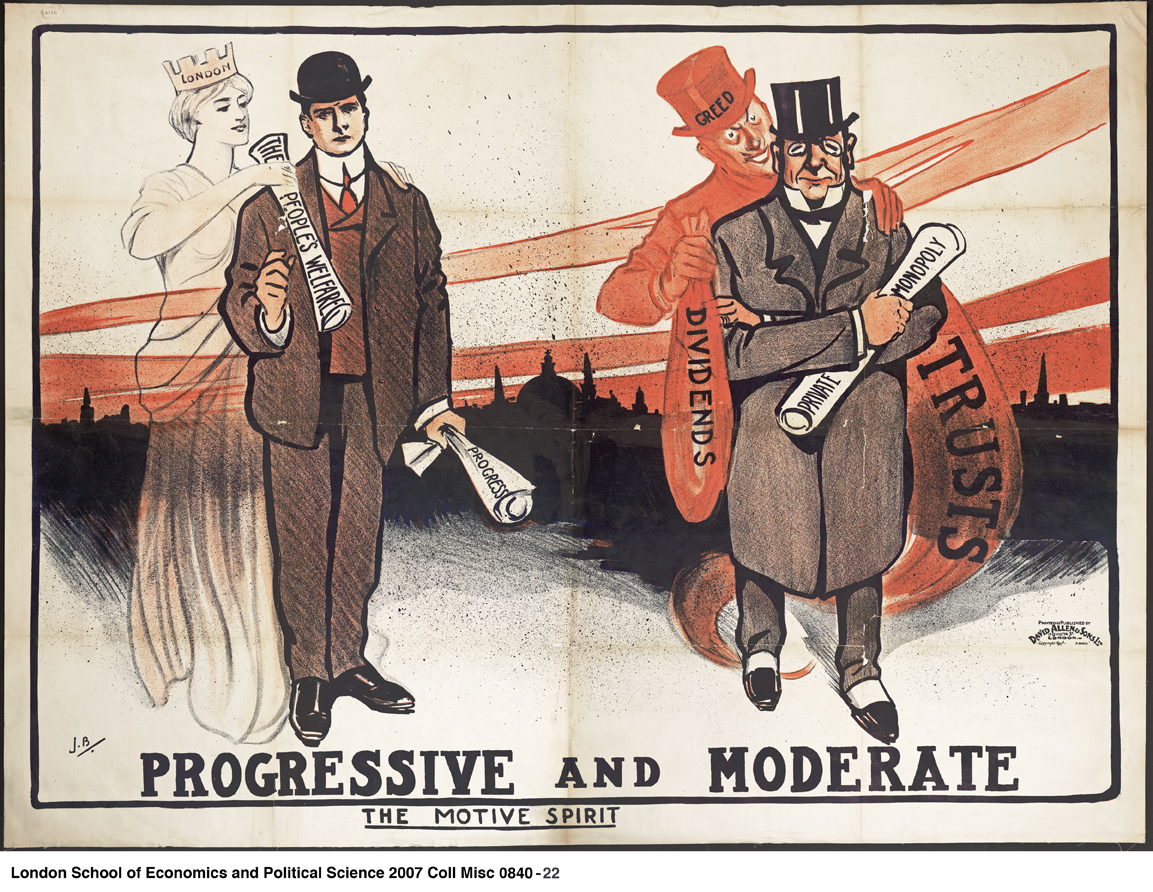
At the beginning of the twentieth century, there was a broad consensus among reformers in the United States regarding the perniciousness of economic monopolies and winner-take-all politics. After that period of rampant growth and cronyism known as the Gilded Age, groups who had been disproportionately disadvantaged by political patronage and voter fraud began to organize…
At the Monkey Cage : “Once again, politics proved to be more complicated than a simple bidding market in which the side that spends more money gets the prize: Money did not seem to matter in the sense that it determined the outcomes. But candidates certainly behaved as if it mattered, which gave – and…
Last year, I suggested that liberal objections to Citizens United were partly justified by predictions about its effects that I didn’t see as probable . As the election draws to a close, we can begin to say whether the consensus view or my own views were accurate. Here goes: as a percentage of GDP, this is…
I originally put this together for my students. On Solitary Confinement: Solitary in Iran Nearly Broke Me. Then I Went Inside America’s Prisons. by Shane Bauer Subjects Without a World: A Husserlian Analysis of Solitary Confinement, by Lisa Guenther The Inhumane Conditions of Bradley Manning’s Detention, by Glenn Greenwald On the Cost of Prisons and Prison…
Peter Levine has been blogging on various aspects of truth recently: democracy in a “post-truth era ,” issues in prediction , and now a piece on scientism : if all truths were scientific truths, we would be in deep trouble. We would then reject any claims that science cannot support. For example, do all human beings have…
Yudkowsky offers to decode the secret : Maybe you see the theorem, and you understand the theorem, and you can use the theorem, but you can’t understand why your friends and/or research colleagues seem to think it’s the secret of the universe. Maybe your friends are all wearing Bayes’ Theorem T-shirts, and you’re feeling left…
A showdown of sorts with Jonathan Haidt is brewing on The Stone. Michael P. Lynch gives us ” A Vote for Reason .” The judgment that reasons play no role in judgment is itself a judgment. And Haidt has defended it with reasons. So if those reasons convince me that his theory is true, then…
The speculative post on empathy generated a great set of comments over on Facebook , but I think the discussion was weighed down by the framing from the original article regarding “Extreme Female Brain.” Those (like Cordelia Fine ) who have rejected the account of autism-spectrum disorders as “Extreme Male Brain” have largely done so…
BPS has a gloss on this paper by Bremser and Gallup , which suggests that eating disorders and social anxiety may be an example of Extreme Female Brain : too much concern about what other people think and feel is associated with fear of negative evaluations, which may be expressed through apprehension and distress over negative…
Deirdre McCloskey describes her project : I have been trying for thirty years to revive the rhetorical tradition, and lately to introduce language into the economists’ models in which talk is cheap and therefore of no consequence. On the contrary, sweet talk, persuasion, is one quarter of national income, earned by managers and teachers,…
Here’s the post: Game theory and the Super PACs . Levine points to the recent shift in campaign finance focus from the presidency to Congress, and adds nuance to a debate that is frequently overrun by absolutist intuitions: No wonder Karl Rove is spending his money on behalf of Senate Republicans. The Center for Responsive Politics reports that conservative super-PACS…
Another way of putting this question is: how does your ideology and social setting blind you? One way to answer is to look at those beliefs that you have the most incentive to deceive yourself about. What are your biases? For instance, I’m probably not as smart or as caring as I think I am, because…
(This post is a continuation of Arendt, Antisemitism, and the Chicago Teachers’ Strike .) Another way of thinking about public sector unionization is as an effort to force democratic public institutions to remain accountable to the professional standards and know-how of those who work within them . Citizens want better, more accountable teachers, yet they…
I am one of those ideologically-impure liberals that worries a lot about public sector unions. On the one hand, I favor workplace democracy and collaboration; on the other hand, I worry about the fact that as union membership has declined, the majority of remaining union members haved tended to be at the top of the…
I try to defend conservatism sometimes . I also like Chesterton . Here’s one reason why: In the matter of reforming things, as distinct from deforming them, there is one plain and simple principle; a principle which will probably be called a paradox. There exists in such a case a certain institution or law; let…
I haven’t written much about status emotions , recently, but I came across one of my favorite Facebook memes and remembered again how central it seems. I don’t endorse the misogyny here, but it perfectly describes the way that fundamental attribution bias transforms resentment into contempt, and thus leads, in my view, to both epistemic…
Megan McArdle’s Newsweek cover story, ” Is college a lousy investment? ” is an odd beast. Parts of it are really great, and there are some very important observations throughout to which my colleagues and fellow progressives should pay attention. But the title, framing, graphics, and many of the arguments are just silly, which makes…
Apparently, they are for losers: ‘To be unable to take his enemies, his misfortunes and even his misdeeds seriously for long–that is the sign of strong, rounded natures with superabundance of a power which is flexible, formative, healing and can make one forget…. A man like this shakes from him, with one shrug, many worms which…
There’s a somewhat disused trend of identifying philosophical methods or schools by the personalities required for them. I associate this with Karl Jaspers’s Psychology of Worldviews and Simone de Beauvoir’s Ethics of Ambiguity, but there are precursor typologies in Nietzsche, Kierkegaard, and William James. It largely fell by the wayside in the second half of…
Yesterday, George Mason University economists Alex Tabarrok and Tyler Cowen announced MRU , a modular course design platform that they’ll be using to offer free and potentially paid courses in economics, online. I’ve learned a lot from their blog since I started reading during the run-up to the financial crisis, and I plan to at…
Most people who know me in person would at least consider using the term “snarky” in their description of me, which is why John Barnes’ polemic against “snark” troubled me so: It’s a currently fashionable powerful rhetorical weapon that allows the uninvolved and the never-to-be-involved to discredit people who do, or attempt – anything at…
George Orwell supposedly* wrote that “Journalism is printing what someone else does not want printed: everything else is public relations.” A piece is journalism if and only if someone does not want it printed. Orwell does not want public relations printed (as if it were journalism.) Orwell is someone. Printing a piece (as if it…
From Foucault’s Collège de France lecture on March 14th, 1979 (in what the publisher has misnamed The Birth of Biopolitics despite the fact that that year’s lectures basically spelled the end of Foucault’s work on biopolitics and focused on the limitation of state control over the market): What does it mean to form human capital,…
In my brief response to Community College Dean a few weeks back , I said something that I think is pretty obvious, but that is often ignored: humanities advocates spend so much time fighting the instrumental approach to education [because] you’ve got to pretend like time doesn’t matter, or else the education won’t work. Consider the…
In responding to my post on the topic, Peter Levine says of “public philosophy” that I am not yet sure what it means or whether I want to be part of it. To me, that is a major indictment. He then goes on to give a useful account of “public scholarship” that we can take as…
Here’s Eli Dourado : In modern society, better jobs and relationships are often the reward for the production of positive externalities. As it turns out, people like to work and socialize with those who create value for others. This effect is pretty strong. Can you name a person who ended up poor and unhappy because they devoted…
My department invited Sharon Meagher to do a seminar last Friday on how to redirect our energies towards “public philosophy.” Meagher has a great textbook for introducing philosophy through an exploration of urban issues that offers a situated approach to philosophical inquiry, and she’s done a lot of work trying to organize and advocate for…
Confessions of a Community College Dean takes on one of my cherished beliefs, that “Administrative Bloat” drives skyrocketing tuition : Never mind that this assertion has been empirically discredited, or that the “supervisory” ranks in colleges have shrunk even faster than the full-time faculty ranks. The only actual growth has been in IT, services for…
The Obama administration brews its own beer Weigel takes a stab at serious policy Weigel has predicated a lot on the conditional statement: “If you look at it right, then you’ll see serious policy.” But we don’t have any evidence for the antecedent, that the public or the media *will* “look at it right.” More to…
It is my considered opinion that the next three months will involve no serious deliberations regarding substantive public policy. Though readership and viewership for such matters will be at its highest, none of the things discussed will be discussed in a way that comports with public reason or with anything like the goal of exchanging…
John Quiggin raises some interesting questions about the BIG+VAT in the comments to the last post: I’m unconvinced by your transition strategy, though of course the nature of a transition strategy depends on the starting point. I don’t see how a ‘small’ [UBI*], say $3000/person/r or $1 trillion per year in the US context let’s…
Interfluidity on the Productivity Effects of Wealth as Insurance: Waldman is excellent and thoughtful, as always. Four Futures: No mix-and-match because futurists never hedge. Why Valve? Sounds like a great place to work, but I’m glad that the DC Department of Public Works doesn’t run this way: I like it when they collect my trash. Tabarrok…
I’ve been dissatisfied with Intense Debate, and I’m trying to see if Jetpack’s comment plugin works better. Please enjoy “Batman Maybe” while testing continues: UPDATE: Testing is complete, but enjoyment of “Call Me Maybe” parodies may continue.
John Quiggin has been taking up the case against the basic income guarantee at Crooked Timber recently. See here and here . Unfortunately, he is attacking a weak man version of the policy. It doesn’t look like he actually opposes the BIG, in theory, but his objections all appear to demonstrate that a Basic Income…
I’ve been putting off finishing my series on the Bleeding Hearts / Crooked Timber debates, because Chris Bertram had suggested that there might be a reply to critics. Now he says it might be a while longer, so I’m going to finish up. In my last post , I suggested that none of the methods…
The virtue of the Crooked Timber bloggers’ objections to the Bleeding Heart Libertarians’ line is that it implicitly suggests the difference between liberal and republican conceptions of freedom. Libertarians have usually substituted theories of interference and coercion for a full-blown theory of domination. When Chris Bertram stopped by, he suggested that they wanted to avoid…
In his initial response to the the Crooked Timber bloggers , Cowen also suggests that he doesn’t like the “mood affiliation” of the CT bloggers: I am not comfortable with the mood affiliation of the piece. How about a simple mention of the massive magnitude of employee theft in the United States, perhaps in the…
Tyler Cowen returns to the issues of employer/employee domination today , but since I never blogged his first response , I want to start working through this debate from the beginning. The Crooked Timber bloggers offered a lengthy list of workplace depredations , and then suggested that these depradations require government intervention in the form…
Charles Stross is doing an “IamA” on Reddit right now. Vincent Ostrom died. (Am I wrong to find this kind of quick death following the loss of a spouse and co-researcher seriously romantic? Probably, but there it is.) Children bully an elderly bus monitor. The internet responds with $650,000 in donations. Also, many plot elaborate revenge…
What follows is a proposal I’ve been working on to convince my university to switch from its General Education requirements to a first-year seminary, given the data in Academically Adrift . Executive Summary The best research available suggests that courses with demanding reading and writing requirements are the only way to teach the core competencies…
[This is an uncorrected transcription of some remarks Hannah Arendt gave to the first annual Conference on the Cybercultural Revolution. I’ve copied it from the Library of Congress, here . Notice that her concerns with the end of work are quite strong in these remarks. Her comments on the necessity of a social safety net in…
On Tuesday we had a university-wide faculty meeting on revising the general education requirements at Morgan State, and predictably President Wilson held up a copy of Arum and Roksa’s Academically Adrift and made some comments about how we had to do better while horribly mangling the actual findings of the book. Though there’s a lot…
I’m thinking of adding rules and a FAQ to my syllabi. Thoughts? Read More. Write More. Think More. Be More. Do the homework and come to class. [Woody Allen has said that “80 percent of success is showing up.” But be sure to show up for your homework, too; there will be approximately two hours…
Let me start with a correction. Anarchy isn’t really as interesting as you think it is. In fact, Anarchy is Boring : Figuring out how to run a sustainable anarchist household (that values time spent washing the dishes and time spent making money as a computer programmer equally) isn’t as headline-grabbing as a downtown smashup….
Peter Levine asks, ” Why do we feel compelled to argue from decline? ” in areas where objective measures suggest progress or growth: You can care deeply about public education, civic education, teenagers’ behavior, or–if you must–gun rights, but there is no basis for arguing that these things are worse than they used to be….
[caption id=”” align=”alignleft” width=”320″ caption=”Blame it on REM”] [/caption] I had the pleasure and discomfort of attending parts of the Reason Rally on Saturday, a march on Washington by atheists, agnostics, and heathens . It was cold, rainy, and frequently quite boring. I mostly went to see Bad Religion , but I enjoyed Eddie Izzard’s…
We don’t normally think of induction and statistics as a part of critical thinking courses, but I think we should. Logic doesn’t end with deduction, after all, and there are few other instances in a college curriculum where students are asked to think carefully about how they ought to evaluate evidence, rather than being asked to apply…
…[S]cience has realized and affirmed what men anticipated in dreams that were neither wild nor idle. What is new is only that one of this country’s most respectable newspapers finally brought to its front page what up to then had been buried in the highly non-respectable literature of science fiction (to which, unfortunately, nobody yet has…
This weekend’s revelation that Mike Daisey’s story about Apple and Foxconn was partly fabricated has led some bloggers and journalists to return to the question of how we should interpret the relationship between something called “facts” and something Daisey is calling “higher truth.” This distinction seems spurious to me, though we often hear it described…
Crazyism about X is the view that something it would be crazy to believe must be among the core truths about X. It’s probably more common than we’d like to think. Some significant portion of professional philosophers can be manipulated into accepting or refusing the Doctrine of Double Effect on the basis of the order…
This Newsnight piece paints a picture of the widespread breakdown of the Greek social compact: What was no joke were the clashes between police and the hardline protesters.[…] Time and again, on the grounds of confronting the rioters, police made incursions into large masses of peaceful protesters. […]I can tell you from repeated experience, it…
I’ve been neck-deep in some writing projects of late, but I wanted to post a couple of cool links and give a hint of what’s coming next: Mark Lance, Daniel Levine, and I will be running a free course at the Baltimore Free School on Freedom. Daniel Levine has been doing some pretty kick-ass work…
Metafilter’s dgaicun shares this meta-analysis on regret, ” What we regret most… and why .” An excerpt: Education is the number one life regret, accounting for 32.2% of all reported regrets (SD = 1.89). This is a strikingly consistent finding, confirmed by a wide margin in all but two data sets (those exceptions being Landman et al.,…
Bronnie Ware was a palliative care nurse who decided to blog about her patients’ dying thoughts and regrets. The blog became a book, and now it is being advertised on the Guardian’s website as an odd list of desert island favorites: ” The Top Five Regrets of the Dying .” I wish I’d had the…
I think about inequality a lot. But I also think about the middle class a lot, which isn’t quite the same thing. Generally, my sympathies lie with the “least advantaged” or “subaltern,” but I also feel the pull of the American cultural commitment to the middle class. There can be little doubt that we are…
Martin Luther King, Jr. on direct action : In any nonviolent campaign there are four basic steps: collection of the facts to determine whether injustices exist; negotiation; self purification; and direct action. We have gone through all these steps in Birmingham. There can be no gainsaying the fact that racial injustice engulfs this community. Birmingham is…
I tried to get tickets after I saw this New York Times piece , but no luck. “I am not throwing away my shot” is just an awesomely perfect refrain: it refers to ‘reserving and throwing away’ the shot in a pistol duel: deliberately firing into the ground in order to make a merely symbolic gesture…
(Caveat Lector: I am not a conservative. However, recent reflections on institutional experimentation have reminded me of some of the virtues of the philosophical movement that goes under that name.) With the publication of The Reactionary Mind , Corey Robin has taken up Phil Agre’s old point that conservatism is the defense of aristocracy and…
Most academics know some version of the critique of elite rule, administrative power, and centralized regulation by experts. Hannah Arendt called bureaucracy the “rule of No Man;” Michel Foucault described the overlap of legislative power, knowledge-production, and the apparatus of discipline and control; Iris Marion Young defended simple street activism against the demand that political…
While there is much more to be said about the risks associated with advocating “experimental disenfranchisement,” I stand by the claim that we cannot ignore the widespread temptation towards disenfranchising ignorant citizens. We must at least acknowledge that the challenge is not simply coming from nowhere: Jason Brennan reflects a widespread, even common-sensical, fear of…
In my last post , I noted that Jason Brennan’s published work strongly opposed disenfranchisement in the ordinary sense, and I claimed that Eric Schiesser had misrepresented his words in order to derive that conclusion. Today, Eric Schliesser supplied an unpublished paper in which Brennan offers an argument for experimentation with competency tests to disenfranchise…
Jason Brennan, The Ethics of Voting, 2011, page 5 : “The right to vote and the rightness of voting are different things. I do not argue that we should disenfranchise anyone. Though I think many voters are wrong to vote, I will not argue that anyone should prevent them from voting.” (Emphasis mine) Eric Schliesser, …
When I was an undergraduate, I took a class called “Truth and Beauty” with the poet Ann Lauterbach . It was basically a class on reading and writing essays, but I took it because I was a philosophy major and I thought it would be about aesthetics, i.e. about whether judgments about beauty can be…
John Keane imagined Havel’s funeral in 1999 : Prague would double in size. As he lay in state in the old Castle of the Bohemian kings above the city, a queue some miles long would spring up. Mourners would wait all day, and all night, to see his body for the last time. The day of the funeral…
Peter Levine’s post on Havel’s 1992 speech in Poland reminded me that I had planned to do some writing about Havel before he died. The New York Times titled his obituary ” A Melding of the Artist’s Politics and the Politician’s Art ,” and yet it focuses only on his writing career and offers not…
Apparently, it did! On Thursday, I produced a graph and some older papers in economics that made the case that there is a pretty clear trend in campaign spending that was completely unaffected by the 2002 BCRA. However, I’m a philosopher, not an econometrician, so I left off the most important part: comparing growth in…
So I’ve just completed grading 55 papers on Citizens United v FEC , and though I’d kind of like to reflect on it a bit, I’m also finding that grading has totally exhausted my interest in the legal questions. (But seriously: the personhood question is a red herring!) Maybe later this week I’ll post…
Today Dr. J encourages her readers to understand the Occupy Wall Street movement through the lens of Aristotle’s Metaphysics: The Occupy Movement is like our sense of sight. It’s not (instrumentally) valuable for what it allows us to see, but rather it’s (intrinsically) valuable in that it allows us to see. Like sight, it “brings to light many differences…
Whenever I talk to students about democracy, I like to emphasize that the original term for democratic rule was isonomy . Consider the account Otanes gives in Herodotus’ History : “[T]he rule of the multitude [plêthos de archon] has… the loveliest name of all, equality [isonomiên]…. It determines offices by lot, and holds power accountable, and…
Most discussions of the Commons assume that common-pool resources are supplied by nature, like the English fields that were available to locals for grazing, cultivation, and hay-cutting until the Inclosure Acts . However, it is equally possible to create new common pool resources for local control. Kojo Nnamdi spent an hour on his radio show…
I’ve been looking for good articles on local governance, in part related to the Tufts Summer Institute, and in part related to my goal of transforming my ethics course so that it takes up the paired questions of the Good Life and the Good Citizen. One resource for this is Sharon Meagher’s textbook Philosophy and…
In his new book 23 Things They Don’t Tell You About Capitalism , Ha-Joon Chang offers a progressive explanation for what Tyler Cowen calls “The Great Stagnation ,” the slowing growth in public goods available for consumption or redistribution. Between his various jibes at a strawman version of the standard economic model, Chang offers a…
I’ve just returned from two weeks at the Tufts Summer Institute of Civic Studies , which culminated in a conference attended by 117 researchers, practitioners, philanthropists, and public officials interested in expanding the role of citizens in our democracy. Peter Levine summed up the conference here : The Frontiers conference was modeled on No Better…
Tyler Cowen writes: I have an irrational fondness for this sentence of Mann’s: The First World War distracted governments from the task of monitoring insect movements. The sentence from Charles C. Mann is quite good, but Cowen’s sentence is better: it encapsulates his exuberance for the written word and for heterodox points of view. (And…
I made the mistake of teaching a set of essays on gay marriage at the end of the semester. I call it a “mistake” because I find it very difficult to give my traditional charitable interpretation to the work of folks like John Finnis and Robert George, who make arguments from a definition of marriage…
Following up their earlier study , John Jay College has produced an analysis of the sex abuse scandal in the US . I think it is mostly quite a good analysis, though there are a few weakness and one or two unnecessarily controversial claims tied to those weaknesses. To my mind, the most crucial section…
One of the major debates in the philosophy of emotions is whether they ought to be treated as propositional attitudes and judgments capable of truth-tracking or simply as moods that can be appropriate or inappropriate to a context, but not falsifiable or verifiable. The question is whether emotions are a kind of intentional cognition or not….
In Ted Chiang’s short story, ” Liking What You See: A Documentary ,” he offers us a typical science-fictional hypothetical, in the form of a staged debate regarding the value of seeing beauty in others. What if you could remove your own capacity to see the beauty in a human face? While at first this…
Literacy is one of the major factors in female empowerment : As female education rises, fertility, population growth, and infant and child mortality fall and family health improves. Increases in girls’ secondary school enrollment are associated with increases in women’s participation in the labor force and their contributions to household and national income. Women’s increased…
Bryan Caplan echoes my own pragmatic/consequentialist arguments for pacifism : P1: The immediate costs of war are clearly awful. P2: The long-run benefits of war are highly uncertain. P3: For a war to be morally justified, its long-run benefits have to be substantially larger than its short-run costs. C: [B]efore you kill innocent people, you should be reasonably sure…
Because of my work on Hannah Arendt, I often struggle with the apparent incongruity between her account of natality and my own tendency towards antinatalism . Natality is at the heart of Arendt’s project, a rejection of the Heideggerian obsession with mortality and being-towards-death: “It is in the nature of beginning that something new is…
Part 1: Forgiveness and the Problem of Irreversibility Part 2: Forgiveness as a Manifestation of Divine Charity Part 3: A Duty to Forgive? Part 4: Prejudice as the Crystallization of Judgments Part 5: Charity as a Flight from Politics Part 6: Publicity without Politics Following Nietzsche, Arendt speaks of the Christian publicity without politics as world-destruction and ultimately as ‘desertification’: “the…
Part 1: Forgiveness and the Problem of Irreversibility Part 2: Forgiveness as a Manifestation of Divine Charity Part 3: A Duty to Forgive? Part 4: Prejudice as the Crystallization of Judgments Part 5: Charity as a Flight from Politics Part 6: Publicity without Politics Auden’s criticisms of Arendt explicily call for a flight into the invisible and eternal world, which comes…
Part 1: Forgiveness and the Problem of Irreversibility Part 2: Forgiveness as a Manifestation of Divine Charity Part 3: A Duty to Forgive? Part 4: Prejudice as the Crystallization of Judgments Part 5: Charity as a Flight from Politics Part 6: Publicity without Politics In order for us to understand Arendt’s “prejudice against charity” properly, we must evaluate her idiosyncratic understanding…
From Understanding Arguments by Walter Sinnott-Armstrong and Robert Fogelin, which I use in my critical thinking course: Ideologies and worldviews tend to be self-sealing. The Marxist ideology sometimes has this quality. If you fail to see the truth of the Marxist ideology, that just shows that your social consciousness has not been raised. The very…
Call the roller of big cigars, The muscular one, and bid him whip In kitchen cups concupiscent curds. Let the wenches dawdle in such dress As they are used to wear, and let the boys Bring flowers in last month’s newspapers. Let be be finale of seem . The only emperor is the emperor of…
Part 1: Forgiveness and the Problem of Irreversibility Part 2: Forgiveness as a Manifestation of Divine Charity Part 3: A Duty to Forgive? Part 4: Prejudice as the Crystallization of Judgments Part 5: Charity as a Flight from Politics Part 6: Publicity without Politics Arendt’s response raises interesting questions: “Of course I am prejudiced, namely against charity,” she wrote. In her letter…
Part 1: Forgiveness and the Problem of Irreversibility Part 2: Forgiveness as a Manifestation of Divine Charity Part 3: A Duty to Forgive? Part 4: Prejudice as the Crystallization of Judgments Part 5: Charity as a Flight from Politics Part 6: Publicity without Politics Having been especially moved by Arendt’s depiction of forgiveness, W. H. Auden wrote a glowing review of…
Part 1: Forgiveness and the Problem of Irreversibility Part 2: Forgiveness as a Manifestation of Divine Charity Part 3: A Duty to Forgive? Part 4: Prejudice as the Crystallization of Judgments Part 5: Charity as a Flight from Politics Part 6: Publicity without Politics In The Human Condition Arendt staked out a position that action’s novel self-disclosure…
I asked Tyler Cowen what he thought of the public policy game show idea . He posted my request for comments, and there has been some helpful stuff from his readers: Sandeep notes that Scott Adams already thought of it: As president, I would solve all the world’s problems by creating a reality TV show…
If you teach philosophy, you should be reading In Socrates’ Wake , a group blog devoted to pedagogy. Here are some highlights: Becko summarizes the “disengagement compact” (and further coverage of Academically Adrift ) Michael Cholbi on testing and study strategies . Chris Panza parses our outlier GRE scores . Discussion of Martha Nussbaum’s Not…
I have a tendency to speak in a way that conflates “evidence” and “reasons.” I’m pretty sure they are interchangeable. When we discover evidence, we discover a reason to believe some proposition. At the same time, reason-giving is the exchange of evidence, even when it is nothing more than the exchange of priors and ungrounded…
John Protevi, Mark Lance, and Eric Schliesser have created a bit of a stir in the blogosphere with their call to shun sexually harrassing philosophy professors: We believe there are informal sanctions that could make a difference. The Feminist Philosophers blog recently suggested not inviting serial harassers to conferences. One could easily extend this to not inviting…
Consider two courses of action: One has a low probability of success but promises to mildly increase welfare (however defined). Call this “meliorism.” Rawlsian liberals, Burkean and Oakshottean conservatives, and Hayekian libertarians frequently identify with this view. Another has an unknown probability of success, but promises to massively increase welfare (however defined). Call this “perfectionism.”…
Square Foot Gardening is a small-scale intensive agricultural method popularized in a book and PBS show starring Mel Bartholomew . It uses raised beds, crop rotation, and a special mix of compost, peat moss, and vermiculite to make urban gardening easier. In retirement, Mel has passed the square foot gardening torch to Patti Moreno , and Youtube…
The war in Libya happened so fast that most of the commentariat seemed to be caught flat-footed. The international community had apparently decided to go to war without properly vetting their decisions with bloggers! As a result, we got more than our fair share of bad arguments. I’ve been trying to formulate a position of…
I’m preparing a version of my review of Anthony Appiah’s The Honor Code for publication, and I was hoping that folks might give me their favorite articles, cites, and quotes on esteem and honor. If any other reviews of Appiah’s book really stood out to you, I’d love to read them, too. In my expanded…
One major defense of status emotions like deference and disdain is that they count as judgments of a person’s character. We defer to experts because they have a history of being right; we disdain scoundrels because they have a history of cheating or misleading us. In this sense, status emotions are akin to other reactive…
There’s been a conflict running through Jonathan Haidt’s work that it’s time for him to address. On the one hand, he asserts that there are characteristic moral intuitions that distinguish partisan liberals from partisan conservatives . He recently argued that these moral intuitions are demonstrated by the fact that the vast majority of social psychologists…
Here’s the gist : I would like to argue that most of the really important public policy issues are not even part of the ongoing debate in the press. Here are some examples: 1. The huge rise in occupational licensing. 2. The huge rise in people incarcerated in the war on drugs, and also the…
Tyler Cowen’s new e-pamphlet ( The Great Stagnation ) takes on the slowing gains to be had from social and technological progress and offers an interesting explanation of some of the trends that many people see as troubling: the flat arc of median incomes since 1973 and the apparently universal surprise that the last decade…
Scu pointed me to this discussion of a Cap and Trade dividend. One issue, which would also apply to a carbon tax + dividend: this would hit exports but miss imports. Contrast that with a plain-old VAT, which hits imports but is refunded on export. This would make our goods less competitive, while encouraging us to…
You know, I may have been looking at the Basic Income + VAT wrong. Instead of using a value-added tax to fund the basic income, perhaps we should use a basic income grant to sell a different policy… the carbon tax! Here’s what I have in mind: the US could adopt a revenue-neutral carbon tax….
Liveable4All dropped this video in the comments to my last post . It’s a short recording of Martin Luther King: “We are demanding an emergency to program to provide employment for everyone in need of a job, or if a work program is impractical, a guaranteed annual income at levels that sustain life and decent…
[caption id=”” align=”alignleft” width=”336″] US Customs and Border Protection officers enforce our labor market protections with paramilitary techniques.[/caption] One of my favorite liberal policies is the basic income proposal. The idea is that all citizens have a basic guaranteed income, below which no one may fall. As the argument goes, this supplies more flexibility than…
[caption id=”” align=”alignright” width=”375″ caption=”The Day of Thugs (Image from Foreign Policy)”] [/caption] It is said that revolution is what happens when a police officer is transformed from a legitimate authority into a man with a gun. If that’s true, then what we witnessed in Egypt yesterday is a classic counter-revolution: irregular hoodlums attacking peaceful…
Will Wilkinson on Bryan Caplan’s (false?) dilemma : Bryan Caplan lays down a challenge to liberaltarians: From what philosophic point of view is “maximizing growth + lots of redistribution + the immigration restrictions lots of domestic redistribution naturally encourage” better than “maximizing growth + no redistribution + free immigration”? Whether you’re concern for the poor is…
Thomas Gregersen quotes Ronald Dworkin on Amartya Sen : It is not helpful, in the world of real politics, only to call for due consideration of a large variety of factors that everyone concedes relevant without also offering some overall scheme to suggest how these different factors should be weighted in a practical decision about…
Responding to the American Psychological Association’s Task Force on Socioeconomic Status , Peter Levine discusses some of the difficulties in measuring socioeconomic status : To take another example: you need wealth and family connections to be admitted to certain snobby clubs. But having wealth and family connections might hurt your chances of hanging out with the…
There’s a pretty fantastic exchange happening in the blogosphere right now, started by Freddie DeBoer here and followed-up here . The substance of DeBoer’s criticism is that there are no legitimate “far left” bloggers, only center-left “neo-liberals” and the panoply of social conservatives, partisan Republicans, and libertarians. Thus, DeBoer charges, we have a blind spot,…
On the Diane Rehm Show today, Jill Lepore echoed Richard Hofstadter’s diagnosis of political violence : I went back and — a few years ago and reread an issue of Newsweek magazine that was published a couple of months after the Kent State shootings, which is, in some ways, a similar moment to this pause and…
In his comments on my post last week , Robin Hanson asked about the conceptual work still needed to advance the cause of prediction markets as tools for governance. To my knowledge, Hanson’s definitive statement of futarchy can be found here : When an approved betting market clearly estimates that a proposed policy would increase expected…
Tyler Cowen, a loyal reader of my e-mails, responds to my question on Michel Foucault . In the process, he recommends The Archeology of Knowledge twice, and notes that Foucault …goes astray by assuming, implicitly, explicitly or otherwise, that structural categories somehow interact with each other in the world of ideas. It’s much more micro and disaggregated…
The immediate response to tragedy ought to be a cautious silence and a quiet search for understanding. Yet when I attended a vigil on Sunday at the US Capitol building , a reporter from WAMU spent a half hour gathering quotes (none of which he used, thankfully) and in the process goaded a few vocal…
Robin Hanson channels and extends Thomas Reid : What can you do about serious skepticism, i.e., the possibility that you might be quite mistaken on a great many of your beliefs? For this, you might want to consider which of your beliefs are the most reliable, in order to try to lean more on those…
Bill Zeller’s eloquent and reasonable suicide note. Down and Out on $250,000 a Year How Luxury Changes People, an interview based on this article: “The Devil Wears Prada? Effects of Exposure to Luxury Goods on Cognition and Decision Making.” There’s a simple reason why the Family Research Council is a hate group: they lie. Sherif Girgis, Robert…
Most philosophers start with the big theories : psychological continuity, embodied persistence, “no further fact” anticriterialism. Yet in a vaguely Parfitian way, I’ve been wondering whether our identity intuitions can or should be forced to line up under a particular theory. So let’s look at some of the intuition pumps and see if they ought,…
I’ve been looking at G. K. Chesterton’s theology lately, but today I came across this : The modern man no longer presents the memoirs of his great grandfather; but is engaged in writing a detailed and authoritative biography of his great-grandson. […]there is something spirited, if eccentric, in the sight of so many people fighting…
Over the holiday weekend, I spent some time with my family watching the series Planet Earth on a high definition television. It was moving and informative, a sublime challenge to our capacities in its global sweep and the depiction of interconnections between the planet’s various ecosystems. I found myself thinking that this was the perfect…
Check out the results here . How to take the news? Should I be pleased that I blog in an accessible style or worried that the blog is only 18% advanced? I think this is a good “first principles” question for philosophers to ask themselves, especially since Google seems to be using sentence length and…
My colleague Joe Pettit has posted a defense of theism that takes up the traditional Christian onto-theological response to the Euthyphro problem . God is the Measure Rather than speak of God as in some sense separate from the moral law, Pettit posits that God is the moral law. That way, there’s no dilemma when…
Hannah Arendt begins The Human Condition with an account of a world in which “speech has lost its power,” where scientific omnipotence is achieved through the manipulation of mathematical equations whose sense escapes even the mathematicians’ capacity to intuit, and the decision to unleash destructive nuclear powers has been foisted upon non-scientists who are even…
Is this the argument ? 1. (Our) wars are unjust. 2. Stopping (our) wars will prevent further injustice. combined with: 3. (Our) wars depend on secrecy in inception and in daily practice. 4. Thus, (our) wars can be prevented by eliminating the secrecy in inception. 5. Moreover, (our) wars can be stopped by eliminating the…
I’m revamping my Critical Thinking syllabus, and I’m looking to ramp up the heuristics and biases section, perhaps to four or five weeks. Most of the material I’ve reviewed is either too technical or too simplistic, akin to the “memorize a list of fallacies” model. I’d like something a bit more in-depth, but I’m balking…
Steven Maloney asked his students to stabilize the budget using the CRFB’s simulator . Some couldn’t do it without making draconian choices that were particularly painful for seniors, or undoing the President’s decisions to preserve troop levels in Afghanistan and extending the Bush-era tax cuts. Some wouldn’t do it: That students would hand in deficits…
The Washington Post tells the tragic story of a new mother’s untimely death by annotating her Facebook page. ( via ) Is this the new model for obituaries ? Friendship is not a gift, or a promise; it is not a form of generosity. Rather, this incommensurable relation of one to the other is the…
Hugo Mercier and Helene Landemore describe an evolutionary psychological theory of deliberative polarization in their paper, “Reasoning is for Arguing: Understanding the Successes and Failures of Deliberation.” From the paper: We suggest that the function of reasoning is not the betterment of beliefs and judgments through private ratiocination and this is why reasoning does not accomplish this task well….
1. Two studies suggest that women apologize more than men. The reason? They are more easily offended, and find more actions more offensive: In Study 1, participants reported in daily diaries all offenses they committed or experienced and whether an apology had been offered. Women reported offering more apologies than men, but they also reported…
If you haven’t read Assange’s own self-justifications , then you can read this summary of them to get a sense of what worried me . Now, Peter Ludlow does a proper study of Assange’s political theory: this is conspiracy in the sense of the original etymology of ‘conspire’ – as in “breathe with” or “breathe together”. …
Megan McArdle discusses budget negotiating strategies . She’s right. Ezra Klein outlines why liberals don’t like it . He’s also right: Obama’s got 156 million people splitting $214 billion in tax cuts and benefits. The GOP’s got 4[.8] million people splitting $133 billion in tax cuts. On a per-person level, the GOP’s tax cuts are…
I’ve been thinking about a game show version of Ackerman and Fishkin’s ” Deliberation Day ” or David Estlund’s ” Queen for the Day .” In both cases, they asked: why not let ordinary folks take a shot at solving our nation’s hardest problems? My question is: why not let them do it on national…
Charles Stross demands better aspirational fictions : “We need — quite urgently, I think — plausible visions of where we might be fifty or a hundred or a thousand years hence: a hot, densely populated, predominantly urban planetary culture that nevertheless manages to feed everybody, house everybody, and give everybody room to pursue their own…
Most liberals adopt some version of the Rawlsian principle that changes in the distribution of goods ought to benefit the least advantaged. This is a principle easily adopted on utilitarian grounds: the marginal utility to be derived from redistribution is quite high. For instance, the difference between the pleasure I currently experience and the pleasure…
So far as I can tell, the news coverage of the latest diplomatic infodump breaks along a line orthogonal to ordinary US partisanship. Either: 1. There’s nothing new here, although the possibility of future exposure may hamper diplomatic efforts in the near term. or 2. Secrecy is bad, here are some secrets. Neither perspective is particular…
From Tyler Cowen : I would not say that “we are now at war with the terrorists” but our situation has some war-like elements. Any persistent war has required major social changes, if only temporary ones, in how the body is viewed and handled. If we are so unwilling to even consider these changes in…
Walmart is planning to open several new ” urban ” stores in the District, and I’m pretty excited about it. ( via ) One of them will be just two blocks away from me, and I plan to shop there. Right now, I do most of my shopping at the rundown, overpriced Safeway or at…
Here’s a question: what books, stories, or essays have changed your mind, and how? ( via ) It’s pretty common to talk about the books that influence us, but I tend to think that these texts make us more ourselves or cement already existing biases: anti-authoritarian teenagers read Ayn Rand, young people of faith read…
I didn’t hear Jon Stewart’s speech from the Mall, so his quote about where real Americans live didn’t hit me until today. I’m guessing his claim was designed to set up the old, tired prejudice that the 495 Beltway is some kind of line that separates real Americans from the DC punditocracy. Given his various criticisms…
It was a policy wonk’s rally. People who know too much to think activism can be effective in the current media environment. People who spent the last decade protesting the war or Gauntanamo to no avail, only to watch the Tea Party become a major force with minuscule numbers because of a television network’s support. I think some are confusing the…
Perhaps a better title for Appiah’s book would be The Shame Code, because his account of the role of honor in policing behavior. For Appiah, an honor code is a set of principles for justifying respect, and his examples show that the drive to pursue of honor and avoid of dishonor can be extremely influential. Many people will do anything to preserve their reputations, and if their society requires them to fight duels, keep slaves, bind their feet, murder their daughters, or mutilate their childrens’ genitals, they will. While folks like me see this as a reason to decry honor, Appiah sees an opportunity: all we need to do is change the code, and the duelers, slavers, binders, murders, and mutilators will change their tune.
He died October 3rd . He had a robust theory of bureaucracy and he worked throughout his life to conceptualize the fundamental disconnect between democracy and totalitarianism. He is perhaps most famous for his book on Machiavelli ( Le Travail de L’Oeuvre Machiavel) which tried to recuperate the political theory from the secular image of “machiavellianism” as…
My last post has generated some controversy on Facebook, where the audience is a bit more diverse, faith-wise, than those who read the blog. I thought it might be useful to continue pressing on the critique of instrumental beliefs with an instructive list of warning signs that your opinions are primarily instrumental, from Robin Hanson…
One of the most common philosophical conversations on the internet is the argument between atheists and agnostics as to which is the more reasonable position. This comes up so often that I thought I’d record some of my reflections on it. In particular, I am mindful that my position is somewhat at odds with my…
NPR has a story about group intelligence : Anita Woolley, an assistant professor of organizational behavior and theory, has been studying what it means to say a group is “intelligent.” So she created teams of two to five people, drawn from 700 volunteers, and asked the teams to solve various kinds of problems. “We had…
If you’ve ever been to my home city, Washington, DC, you’ve probably noticed that the license plates say “Taxation without Representation.” That’s because DC residents (like Puerto Ricans and inhabitants of the US territories and “overseas possessions”) are not represented in Congress by voting members. Instead, we have a non-voting delegate , much like the…
Following up on my claim in the last post that “honor produces error,” in my view, the problem is epistemic privilege, i.e. deference. By deference, I mean the epistemic privileges that some people receive or earn through demonstrating their erudition or looking like they know what they’re talking about. When you think of deference, you…
Dr. J responds to my criticism of her position on plagiarism detection. I am, she accuses, guilty of Cold War paranoia and preemptive warfare with my students: That is to say, the classroom is a millieu in which everyone is suspicious and noone can be trusted, so every preemptive security mechanism one can employ should be employed. This is,…
Dr. J protests that her school has purchased access to the service Turnitin.com : If I participate in Turnitin, I am negating their Honor Code promise and, effectively, treating my students as if they never signed it. Quite simply, I do not know how I can reasonably expect students to take the Honor Code seriously…
Dr. Trott has a nice post over at Mahogany Feed on Terry Jones’ threat to burn Korans over the weekend to commemorate the attacks of September 11th and to remind Muslims “not to push their agenda on us .” Dr. Trott suggests that this threat to burn the holy book of a cultural group, with…
In a previous post , I argued deception robbed sexual and marriage partners of their capacity to grant informed consent: attempts to reduce consent to the simple act of saying “yes” actually ignore the ways in which fraudulently representing oneself may be coercive. We can hate the bigotry and prejudice that make the lies seem…
Moral Camouflage or Moral Monkeys? An individual psychology primarily disposed to consider the interests of all equally, without fear or favor, even in the teeth of social ostracism, might be morally admirable, but simply wouldn’t cut it as a vehicle for reliable replication. Such pure altruism would not be favored in natural selection over an impure altruism…
If you lie about your ethnicity in order to procure consent for sex, is that rape? Sabbar Kashur, 30, was sentenced to 18 months in prison on Monday after the court ruled that he was guilty of rape by deception. According to the complaint filed by the woman with the Jerusalem district court, the two…
In a post on the fate of the university, Steve writes : We appear to have a situation where the public will not invest in education because it is more concerned in distributing the state’s patronage to older citizens, which has created an education system which has had to cut spending on public service, and…
Was the credit crisis like an asteroid impact? A Thomist take on Hayek and ‘Scientism’: Part 1 and Part 2 An answering machine can help nudge us into monitoring our energy usage Implicit racial bias in empathic responses to the pain of others Does Stuart Buck’s Acting White echo the claims of Akerlof and Kranton’s Identity…
A portfolio theory is a way to minimize risk by diversifying one’s commitments or investments, using hopefully countercyclical strategies so that some part of your portfolio is always growing. Tyler Cowen suggests an amusing epistemic portfolio theory : That is, most people have an internal psychological need to fulfill a “quota of dogmatism.” If you’re very…
My focus in this project is to look at various institutions that try to track the truth about moral value, of which the Roman Catholic Church is only one. The Catholic Church is certainly wrong about consensual adult homosexuality, but what’s interesting is that this error is the result of a method of moral inquiry…
A brief rejoinder to the blogger at St. Angilbert Press [EDIT: The blog is now parked by spammers, so I have removed the link] who claims that Ratzinger’s letters regarding the treatment of homosexual priests (which for him would include the so-called ephebophile priests who molested post-pubescent boys) are not infallible because they seem… to be…
It’s been a few months since I promised a series of posts on the Catholic Church and epistemic institutional design, but I have been working on it. As the Pope marks the end of the aptly named “Year of the Priest” today , I thought I’d return to it. In this post, I will show…
Last year, I wrote : I’d like to see what a surviving-a-day-at-a-time hero looks like. Whatever collection of writers can come up with that story and characterization will make a lot of money breaking with the current anti-hero conventions. More to the point, it might be good for us. Though we may [not] have had…
Last week, Greg Mankiw posted this graph without comment: I thought there was something weird about the graph, and it’s been nagging at me. For one thing, it compares the bottom four quintiles to the top 5 percent of Americans. For another, it ignores non-federal taxation. (State and local taxes are more difficult to calculate,…
(This post is especially for my friends who are reading William Gaddis’s The Recognitions right now.) Post-structuralist trickster or stuffy monetarist? You guess: If modernity is characterized by loss of the sense of the real, this fact is connected to what has happened to money in the twentieth century. Everything threatens to become unreal once…
In the wake of Arizona’s attempt to localize immigration enforcement , I think it’s time for Congress and the Obama administration to return to immigration reform. If anything can justify American exceptionalism , it’s the waves of immigration that have repeatedly demonstrated that we can offer a better life to foreigners without losing our own…
DIY U by Anya Kamenetz (2010) A regularly updated version of this guide can be found here. I teach at the third-most expensive school in the country, where I regularly persuade students that they should major or minor in philosophy. For many students, this is a value question, and as I like to put it,…
Ever since I wrote negatively about the justice of procreation , I’ve been hoping that someone would come along and take the positive position. It’s the kind of argument about which one doesn’t quite want to be right. Sadly, there’ve been no takers. However, there’s recently been a spate of discussions on a more narrow…
Often when I am trying to explain problems in the modern political landscape or my own approach to political philosophy, I will return to Max Weber’s account of bureaucracy as more efficient than private office. Yes, I’ve heard all the jokes about “efficiency” in bureaucracy, but Weber’s argument rested on the contrast between private and…
My latest experiment is to try to write my public policy posts at a new collaborative blog Modest Sites and preserve this blog for more philosophical fare. The title comes from Sheldon Wolin’s classic work of political theory, Politics and Vision : The power of a democratic politics lies in a multiplicity of modest sites…
Late night television takes on moral particularism : via Peter Levine I’m still trying to get my head around Dancy’s view, so perhaps this post will be more confusing than it ought to be. Here’s the gist from the Stanford Encyclopedia: Moral Particularism, at its most trenchant, is the claim that there are no defensible moral…
The Catholic Church has been having a rough time of it lately . In a series of posts, I want to take up some of the implications of this trouble for epistemic institutional design, that is, for building institutions that ‘get it right.’ First, some background: what has previously been a primarily American problem of…
This is from a poster session I did at Penn State University last Sunday. It’s incredibly simplistic, as all posters probably end up being, but it was kind of a cool experience so I’m sharing it here. Click on the image to get a closer look: I now support the use of posters to display…
In the comments to a post on Republican obstructionism, my old colleague Will Roberts proposes the following historical counterfactual : if the American left had been willing to fight harder and dirtier, they could have prevented or arrested the war in Iraq. He goes on to propose a variety of actions that might have achieved…
I’ve linked to Warren before , but my favorite public policy theorist/practioner has a new lecture on regulating consumer financial markets, which is only ten minutes long and very persuasive: Elizabeth Warren on Consumer Protection (MMBM) from Roosevelt Institute on Vimeo . Also, from this recent interview : The consumer credit market is broken. While…
So after my last Tea Party post , I’ve been trying to track down more information about the movement. One interview does not an investigation make. Here’s what I’ve dug up: Evan pointed me to The Next Right. Not the Tea Party, but a similar attempt to reconstitute the conservative party around less jingoistic and racist…
What would you do with $100 and a case of altruism ? How about giving away umbrellas during a rainstorm: David Ibnale had no idea how tough it would be to give away umbrellas on Market Street the other day. He figured that he and his free umbrellas were going to change the world. The world…
The New York Times’ article on Tea Party ‘founder’ Keli Carender, struck me as an interesting corrective to much of the treatment of the movement as either a Fox News ‘stunt’ or a wing of the Republican Party run by the same old white men with a few token non-males and non-whites. Carendar is apparently…
Infinite Th0ught offers this op-ed by Alain Badiou : The living proof that our societies are obviously in-human is today the foreign undocumented worker: he is the sign, immanent to our situation, that there is only one world. To treat the foreign proletarian as though he came from another world, that is indeed the specific…
We are commonly understood to have a right to procreate. For instance, it is a clear violation of that right to coercively sterilize those judged unfit . However, there is some question whether this right includes the right to assistive reproductive technologies, and whether it is defeasible in any circumstances, i.e. whether we have a…
Generally, I respect Harvey C. Mansfield’s work on classical political theory , and think his attempts at contemporary cultural and political criticism are absurdly small-minded. His piece in The Weekly Standard on Obama’s non-partisanship is a mixture of the good Mansfield and the bad Mansfield, so I recommend it to fans of ambivalence. Here are…
I’ve just returned from the Understanding Humans through Neuroscience conference at the American Enterprise Institute , where I heard papers by Roger Scruton, Walter Sinnott-Armstrong, and Stephen Morse. What struck me was how mired the three papers were in defending against a certain kind of agency-undermining determinism that few people take seriously any more. All…
Let’s get the jokes out of the way: “If corporations are people, do they get to vote?” “If corporations are people, can we start incarcerating them when they commit crimes?” “Does this mean I can marry my bank?” “Does charging a fee for incorporation constitute an unconstitutional violation of their reproductive rights?” “Thank God we’ve…
The concluding paragraph of Virginia Woolf’s A Room of One’s Own kinda gives me chills sometimes: For my belief is that if we live another century or so—I am talking of the common life which is the real life and not of the little separate lives which we live as individuals—and have five hundred a…
My old boss Ted Kinnaman has a piece in the Huffington Post on Pat Robertson’s claim that Haitians deserved the recent earthquake because they made a pact with the devil in order free themselves from colonial slavery. Others have developed the historical case for such a pact . Where many have taken Robertson to task…
Robin Wright reviews the three manifestos: The statements set tough preconditions for a political truce: resignation of the current leadership, introduction of broad democratic freedoms, prosecution of security forces engaged in violence against the opposition and an end to politics in the military, universities and the clergy. The proposed reforms would amount to a total…
Going to graduate school in the humanities, especially in philosophy, should be similar to converting to Judaism . Like rabbis, a student’s undergraduate professors should serve as a formal (but slightly secretive) part of the graduate school admissions process, situated as an obstacle or test for the student’s commitment. They should bend their efforts to…
I won’t spend much time justifying the duty to assist now, except to link to Ramsey Clark’s essay ” Haiti’s Agonies and Exaltations ,” but I do want to talk about the kinds of assistance we can offer: Personal: in the short term, we can all text “HAITI” to 90999 to give $10 to the…
I’ve recently realized that there’s a pretty massive network of blogs devoted principally to philosophy, and I’m slowly adding them to my news feed. So what should I be reading? I already have PEA Soup (whose collaboration with Ethics looks quite promising.) I’m a longtime fan of Public Reason . Similarly, I recently discovered Philosophy,…
A friend suggests that my recent arguments against the moral status of contempt ignored an important role it plays in policing our moral community. The concern is that if we cannot feel (and expect others to feel) contempt for someone like Bernie Madoff, then we will lose the morally instructive value of punishment. If we…
The newest issue of The Good Society has been released, with a symposium my friend Steven Maloney and I put together on epistemic proceduralism. It features contributions by James Bohman , Corey Brettschneider , Noëlle McAfee , and Robert Talisse and Michael Harbour . The ‘utopophobia’ in the title comes from David Estlund’s book Democratic…
Ever since the markets became front page news, I’ve been caught in some sort of economics blog vortex. At this point, most of my reading is no longer directed towards macro-economic issues and institutional critique, but rather focuses on the economics department at George Mason. The problem is that it seems like these people really…
[caption id=”attachment_3357″ align=”alignright” width=”484″] “Hey, look at those assholes over there. Ordinary fuckin’ people. I hate ’em.” -Repo Man[/caption] In this post, I want to argue that disdain, contempt, and scorn have no moral place in our emotional lives. In short, my claim is that these emotions are immoral because they target persons and not…
I understand why folks do retrospective blog posts and best-of lists in early December, and I certainly benefit from it as I’m thinking about Christmas gifts, but it seems to violate the spirit of the list or retrospective itself to start before the year or decade is done. If this is the *only* lesson that…
I’ve been having a debate on a friend’s Facebook page about the value of Martha Nussbaum’s work (I’m a fan) and serendipitously I found this post on “appreciative thinking” via Tyler Cowen . It’s a kind of inverted critical thinking, from Seth Roberts: When it comes to scientific papers, to teach appreciative thinking means to…
Can Liberals Take Their Own Side in an Argument? (PDF) Robert Talisse takes on Robert Frost and Mozert v. Hawkins . Epistemic dependence is unavoidable because every individual has limited cognitive resources. However, this dependence in itself is not a bad thing; great stores of knowledge and information that could not be produced by a…
In a recent report on British policing , Denis O’Connor criticized the growing use of paramilitary policing in the UK: “British police risk losing the battle for the public’s consent if they win public order through tactics that appear to be unfair, aggressive and inconsistent,” he said. “This harms not just the reputation of the…
When I am feeling thoughtful and imprecise, I like to say that philosophers embrace disagreement and pluralism because we are not, ultimately, ‘friends of wisdom’: we are practitioners of an ancient art of ‘wise friendship’ in which our disagreements and disputes are understood as a part of a larger project of amicability or relation. We obsess over…
Dr. J responds on moral realism. It appears that our dispute focuses on the role that ‘the world’ plays in verifying our moral propositions. Dr. J is right to note that I’ve made an important and potentially dispositive claim in asserting that agent-neutrality requires that one’s account be “either verified by the world or not.” However, I…
David Brooks writes : The disadvantage [of Obama’s style of governance] is the tendency to bureaucratize the war. Armed conflict is about morale, motivation, honor, fear and breaking the enemy’s will. The danger is that Obama’s analytic mode will neglect the intangibles that are the essence of the fight. It will fail to inspire and…
So I’ve been writing the last few days on a number of only tenuously related themes: cruelty and torture , probability and prediction markets , testability, middle-range theories, and moral realism . Today I’m going to try to draw these themes together and point to a couple avenues for further discussion. Obviously, it’s important to…
I’m just reposting a couple of links from Metafilter’s Optimus Chyme : Everything You Never Wanted to Know about the American Prison-Industrial Complex Prison Nation Don’t click through if you were hoping to maintain your post-holiday glow. This is the sort of thing I hoped would be on the agenda by now. For all the…
Yesterday , I called myself a moral realist, which is to say that I believe that some claims about values are agent-neutral. Going back to testability, I suspect that one place that markets will not yield much benefit is in evaluations of normativity. Despite the fact that I am a moral realist and believe that…
(What follows are some reflections on two related problems. One is Robin Hanson’s discussion of prediction markets to counteract status quo bias , and the other is my friend Leigh Johnson’s meditation on strong moral relativism . Because of length, I have cut my extended reflections on Dr. J’s “strong relativism” for a post tomorrow.)…
Throughout the nineties, and to some extent in the last decade, there has been a certain brand of political thinker who just can’t imagine the motivation for cruelty. So alien is the concept that these folks (Richard Rorty and Judith Butler, for instance) have developed a deflationary theory of moral philosophy that simply advises us…
Lin-Manuel Miranda has a rap concept album in the works on Alexander Hamilton. I’m a big Hamilton fan (doesn’t everybody have a favorite founding father?) and so this gives me great joy, as does this video of him debuting the first song at the White House: Who was Alexander Hamilton ? Bastard , immigrant , …
Apologies for Heidegger’s Nazism take a few different forms. As I mentioned yesterday , some apologists, call them the Orthodox Apologists, try to show that Heidegger himself simply forgot the lessons of his own early work, or retreated into errancy. At worst, his later Nazi pronouncements betrayed that early work by appropriating fundamental ontology for…
I’m generally opposed to “Great Man” theories of the history of ideas. My preference is for folks like Derek Parfit who acknowledge that philosophy is a discipline that builds on the work of one’s predecessors and that showing clearly why a bad idea is wrong can be tedious but also more useful than the flashy…
Inspired by Sir Ian McKellan’s reflections on Richard III here and here , and this excellent resource on the historical Richard III, I’ve been thinking about designing a course around villains, moral monstrosity, and evil. Perhaps I’m just a nerd, but this is something I like to sit around doing: arranging texts and problems around…
Dr. J has been riffing on the phenomenon of the ‘uncanny valley’ lately . ‘ For those who don’t know, the ‘ uncanny valley ‘ is a theory for why we find some human-like artificial things so weird. My favorite example is dolls, as this image suggests, but masks are also good examples and ultimately Masahiro Mori…
A candidate trying to decide between graduate schools recently asked me which “types of public administration, political, or civic problems you are attempting to provide solutions to with your research? For example, which questions are you tackling right now?” Of course, right now I’m grading. But in a slightly more general sense of “right now,”…
Economists have long been fascinated by the biological role of “costly signalling.” Think of the peacock’s plumage. In biology, signalling is generally about mating . The idea is that the peacock’s absurd feathers are difficult to maintain, and a female peacock who notices his plumage will have to acknowledge that he must be pretty fit and…
After all the hype, and the promise of a powerfully political sci-fi movie, of course I had to see District 9 . In many ways it’s an enjoyable film, and if it had been set on Mars or in another galaxy far, far away, I think it would have deserved the laudatory treatment it’s receiving….
1. Peter Singer comments on Michael Vick . ( Previously ) My sense is that symbolic punishment of a celebrity may have lasting effects, but I worry that this is more about race than it is about animals, and Singer picks up on that. 2. Southern Poverty Law Center reports on ” The Return of…
This controversy is moving more quickly than I can keep up, unfortunately. 1. khateeb88 has taken down the original image. This follows the revelation that he is a Chicago engineering student whose primary frustrations with Obama began when he picked Rahm Emmanuel as chief of staff, who Khateeb believes to be pro-Israeli and thus evidence…
Let me start by saying that this poster makes me mad. I hate the way ‘socialism’ has been turned into an epithet, and I hate the way that epithet gets used against a fairly market-oriented politician like President Obama to keep him from straying too far into egalitarian policies. Also, I see this image of…
1. The image to the left is by the Iranian painter Feeroozeh Golmohammadi . 2. I’m not generally a fan of protectionism, but here’s a list of great American companies that make stylish and cool stuff . 3. Why meetings are bad for creativity : makers schedule their time in half-day chunks, managers in hour-long…
Dr. J responds with her typical lucidity to my contribution to Chris Long’s podcast series . Using Derrida’s critique of the Platonic distaste for writing, she suggests that: “all written words are vulnerable to being de-contextualized and re-contextualized, such that the distinction between the meaning that the “author” intends and the meaning that the “reader”…
What role does the critic play? Why do we need someone to stand between us and the art, analyzing, recommending, and denouncing? Why can’t we just have our own experience, unmediated by someone elses taste? In my last post , I managed to grab the attention of some folks in the sci-fi publishing world who…
Last week I did a Skype interview with Chris Long for his podcast on Socratic Politics and digital dialogue. We talked about Arendt, anonymity, and an attribution theory of identity. Listen here , or subscribe through iTunes . The whole series can be found at Chris’s blog , where he also posts personal reflections and…
I was just reading this interesting takedown of the shortlists for the 2009 Hugo awards. Apparently, most of the books on the list aren’t very good. I only know two of the nominees for best novel, and one of them, Neil Gaiman’s The Graveyard Book , was actually read to my wife and I by…
1. Tyler Cowen’s Ethnic Dining Guide is my new favorite DC thing. Ah, hell: just read the guy’s blog . 2. William Galston has a blog?!? Apparently he’s not too happy with the health care plan. 3. What about urban infill housing? EYA thinks that Hyattsville, MD can be the next U Street. 4. Is…
So far, McArdle is definitely earning the praise heaped in her direction. She has a post today on health care innovation where she captures the market-based argument against single-payer health care without ever mentioning it. Citing two other bloggers, Glenn Reynolds (actually an op-ed at the Washington Examiner… blog, rag; tom-ay-to, tom-ah-to) and Andrew Biggs…
1. I’ve been back from Costa Rica for more than two weeks now, but even my celebratory blog post has taken back seat to a paper and symposium on David Estlund’s epistemic proceduralism I’m writing and editing with Steve . 2. The Parfit reading group is still on, but if I’m going to be writing…
I haven’t heard from Leigh, so I’m posting this mostly as a placeholder. Feel free to jump in with comments, questions, or discussion on chapters 2 and 3 of Reasons and Persons . My own comments: chapter 2 raises a number of fairly conventional rational choice problems. I first became acquainted with these in thinking…
This is my commentary on the first chapter of Derek Parfit’s Reasons and Persons, part of the online reading group I proposed here . If you haven’t gotten the book yet, you can follow along here for at least the first chapter: I think Google will only let you read fifty pages at a time…
After my recent brush with cultural commentary , I’ve been thinking about the business of art and media criticism. Sometimes I wonder whether a philosopher ought to be in the business of diagnosing the Zeitgeist. Nonetheless, I keep finding myself drawing general conclusions from cultural trends, predicting an uncertain future or analyzing something as grandiose and…
Derek Parfit is widely regarded as the most interesting ethicist working today. Many have performed their work more provocatively, some may be more original, and I suspect that a few (Sen and Nussbaum, especially) have made more progress in the field, but Parfit definitely has captured our attention with his quest for “Theory X,” that ethical…
The Quiet Coup : In my view, the U.S. faces two plausible scenarios. The first involves complicated bank-by-bank deals and a continual drumbeat of (repeated) bailouts, like the ones we saw in February with Citigroup and AIG. The administration will try to muddle through, and confusion will reign. Boris Fyodorov, the late finance minister of…
During my talk at GW on Friday, one concern emerged as the dominant theme, and I stumbled a bit in responding to it. Basically, it’s a version of the Platonic anxiety about democracy: if deliberative institutions give demagogues and sophists equal time to peddle their emotive rhetoric alongside earnest activists and critical thinkers honestly seeking…
I’m taking stock of my reading. Almost every morning, I wake up, pour a cup of coffee, and log on to the internet. Unless I still need to prepare my class notes, I’ll generally click through what I’ve come to think of as a standard set of sites to stay abreast of news and ideas:…
Amor Mundi is Improv Everywhere’s stock-in-trade, but in their latest installment they’ve really put it on display. Service Changes cites the frequent delays and frustrations of metropolitan commuting, but in this case it denotes that joyful creativity for its own sake the Improv Everywhere likes to showcase. Perhaps my favorite thing about this group…
I’ve been struggling to complete a blog entry on the recent trend towards experimental philosophy (X-Phi) for more than a week now. ( What’s X-Phi? , The New New Philosophy , Dr. J’s Take ) However, I’ve been trying to push some other writing out the door, and so it keeps taking a back seat….
In the 1961 case Mapp v. Ohio , the Supreme Court declined to protect the the possession of pornographic material, but instead decided to exclude all evidence gained through unconstitutional searches. Last month, the Supreme Court revisited that decision in Herring v. United States , where they reconsidered the rule of evidence that excludes evidence gained…
As a part of my continuing series (previously: Techniques , More Techniques ) here are two websites that’ll remind you that the proper object of love is the world that makes all loving possible: The Speculist’s “Better All the Time” points out new and cool inventions and discoveries that show that the future is full…
There’s a great little article about prison growth and reform over at Slate . Fordham Law Professor John Pfaff notes that prison populations in the United States have grown unsustainably large, and suggests that this recession is a good time to reconsider our illusions about the causes of that growth. He then goes on to…
Let’s talk about accounting. I’m a political philosopher, not an accountant, but philosophers engage with values and pricing in at least two ways: 1. ARBITRAGE: Philosophy is a kind of arbitrage. 2. THE GOOD: Normative theories like those discussed in the study of ethics, aesthetics, and politics depend on an account of value, i.e. the…
I’ve always loved the cautious understatement in the title of Rawl’s A Theory of Justice . There’s a kind of bad faith humility implicit in the claim that you’re just offering the world another account of right and wrong, to be set on the shelves next to all those other cockamamie normative theories: nothing special, move along….
[What follows is some dissertation-writing that I think is accessible to my blog readers. I had begun to amend it for SPEP before I gave up on the dual-submission idea, but it was close enough to the blog format that I thought I’d keep going and see what happens. Though I acknowledge this is a…
Look, if you’re not already subscribed to the Boston Globe’s Big Picture , then you’re crazy or you hate the awesome. But still, on the off chance you need more persuading, check out this photo spread of the 2009 Tough Guy Challenge in the UK or this one that aggregates some scenes from Indonesia over…
Over at GonePublic , my fellow Masonite Noelle McAfee has a post on the White House’s new Office of Citizen Participation, directed by ex-Google product manager Katie Jacobs Stanton . After a quick moment of congratulation, Dr. McAfee moves on to the critical reflections: Who is engaging whom? how? for what? At present, there’s little…
Laws are like sausages: you can’t enjoy them if you know how they’re made. This is doubly true for budgets and stimulus bills. That said, during the campaign American Public Media put out this nifty little Flash game that puts you in charge of the Federal budget, and in the spirit of self-governance (and wasting…
[caption id=”” align=”alignleft” width=”130″ caption=”Jason Furman, Economic Advisor”] [/caption] Following my last post, I’d like to address the provenance and fate of two websites, and what that means for contemporary politics: publicmarkup.org and whorunsgov.com . Public Markup is a site that lets readers read and comment on bills proposed and under consideration in Congrees….
I listened to Obama’s first presidential radio address yesterday. The presidential radio address hasn’t changed much since Roosevelt’s fireside chats, but as I sat listening to it, I felt like many of Roosevelt’s listeners must have done: though many things are out of my control, my role as a citizen has been exhausted in electing…
As a part of my continuing series in novel and cool things to be excited about, there’s the antiquarian and cool: Lars Brownworth ‘s podcast history of the Byzantine Empire through profiles of 12 Byzantine Rulers . It’s the perfect encore to Mike Duncan’s The History of Rome . (Also good: Isabelle Pafford’s History 106B course…
So, my last post was based on the premise that heroes in zombie movies make the bare act of survival extraordinary, displaying the virtue of subsistence. I associated the need for such heroes with recession. I had in mind the claim that economic growth is associated with ‘surging’ and economic recession with ‘dwelling,’ a distinction…
My friend Dr. J has been talking about anti-heroes for several years now . It was she who first introduced me to the beautiful cruelty of Dexter , a show whose third season I am eagerly anticipating on DVD (so no spoilers, please!) She recently directed my attention to Joshua Alston’s Too Much of a…
2008 wasn’t exactly the year of the blog: Twitter cut into my blogging a bit, as did life in general. As a result, I don’t have a long post to offer at the beginning of the year, as I would like to do. Instead, here are some things on my mind. Still working on personhood…
For a philosopher, I do a shockingly small amount of metaphysics. This is usually not a problem: I can handle basic issues in materialism and idealism, for instance, and tackle mind-body monisms and dualisms with my students, and my scholarship is in political philosophy and I generally argue, along with Rawls, that matters of justice…
Mumbai Under Attack . We know so little about what is happening there that these photographs are almost better than the print journalism. Beware: many of the photographs are difficult to see. [caption id=”” align=”aligncenter” width=”495″ caption=”A resident takes cover for possible return fire as National Security Guard commandoes fire at suspected militants holed up…
I’ve been really troubled by Proposition 8’s passage in California. It’s a strange kind of melancholy, because I’m already married, and I live in the DC area, so there’s no practical impact on me at all. Trying to explain this weirdly vicarious disappointment, I realize that it was arguments about marriage equality that first convinced…
Out of the mouths of babes : Hank Paulson, Treasury secretary, indicated that the US would accept some criticism. “We have in many ways humiliated ourselves as a nation with some of the problems that have taken place here.”
When Antoinette and I got engaged, I purchased a cultured (i.e. synthetic) diamond , concerned about the role that the diamond trade plays in provoking conflict. Here’s what it looks like . At the time, I seriously considered using a saphire, since I believed the trade in saphires was child-labor free and less tainted by…
Arbitrage is the practice of exploiting price differentials for a profit. Arbitrage is based on the Law of One Price: “in an efficient market, all identical goods must have only one price.” From the arbitrageur’s perspective, price differentials are violations of the law, and they profit from correcting the differences. The most basic form of financial arbitrage…
Long time no post, right? Too much work, too little time. Anyway, here’e what I’m thinking about today: George Soros on Bill Moyers Journal: You see, for the last 25 years the world economy, the motor of the world economy that has been driving it was consumption by the American consumer who has been spending…
This blog was posted over at metafilter and got deleted for being too political, but I like it: Do you know what the light at the end of the tunnel is for us? Food. Yeah, food. When we’re on patrols and house clearing missions, what’s keeping us going is not the promise of freedom and…
Three Slate articles caught my eye today. On the Big Sort, Bill Bishop argues that the McCain ad accusing Obama of supporting sex ed for kindergardeners is a kind of dog whistle politics. Bishop gives the history of opposition to sex ed in schools going back to the textbook wars of Kanawha County, WV in the seventies, and…
One of our household’s favorites holidays is Constitution Day ! On this day in 1787, members of the Constitutional Convention signed the final draft of the document that governs us all. Since 2004, all schools who receive federal funds have been required by law to hold educational events on this day. Even if you’re not…
Remembering David Foster Wallace: Really, though, I knew him as a reader knows a writer. I thought I could see him, even if he couldn’t see me, even if he couldn’t (clearly) see himself. […] However, all great writers — and I have no doubt that he was one — have a preeminent purpose: to tell the…
This site isn’t really for partisan cheerleading. I’m a US citizen with policy and party preferences, but I feel that those preferences are somehow irrelevant, especially since my work in political philosophy is mostly oriented towards expanding the definition of the word ‘politics’ to include more than just voting and partisanship as sports team rivalry….
Probably my readers have all heard the old joke: Mathematics is the second cheapest department to run, because all you need are pencils, paper, and waste bins. Philosophy is the cheapest, because you can dispense with the bins. The implication is that we hold on to everything, even bad ideas and bad work. When I…
This has been bruited around the internet for a few months, but I just wanted to throw a shout-out to the Boston Globe’s Big Picture site, which posts photo-essays every week using beautiful, mammoth photographs of daily news. Check out their coverage of the the Olympics , the Large Hadron Collider , and the coronation…
Professor Leiter of Philosophical Gourmet fame has posted his evaluation of philosophy as a discipline here . Some highlights: “In scholarship on the history of modern and ancient philosophy, the interpenetration of scholarly cultures among the Anglophone, German, French, and Italian philosophical communities is now essentially complete.” Thank God. He acknowledges that the sociology of…
In this video, you can see a January 2007 lecture by Giorgio Agamben, in which he discusses his project, “The Power and the Glory.” (Parts 2-6 can be found here .) Adam Kotsko is a Divinity Student at the Chicago Theological Seminary, and he’s recently done the English-speaking world a great favor by taking detailed…
One of my long term projects is to work out a onto-politico-theology of bureaucratic forms of governance. I know that sentence sounds jargonistic, but basically I mean that I’m interested in evaluating proceduralist political theories, the administrative state, and the sociology of bureaucratic organizations against the metaphysical assumptions about the Good and the Right, the…
Antoinette and I were married this past Saturday at the Hershey Hotel in Hershey, Pennsylvania. You can find some pictures at our Picasa Web Album , which we will continue to update, and the text of the ceremony (excepting the vows) at our blogspot devoted to the wedding . Since linking to this information is…
Peter Levine offers an imaginary speech by Barack Obama, responding to the charge of celebrity : “Modern celebrity culture is a terrible thing. I can hardly believe that my daughters, growing up two generations after the height of the women’s movement, should be exposed to relentless news about someone who happens to be thin, blond,…
Preparations are now almost complete for the wedding next Saturday. Antoinette’s amazing powers of organization have really made the process manageable and calm, although now we’re starting to see people worrying that they ought to be doing something: anxiety at the lack of anxiety, I guess. In just under a week, we’ll be married! Some…
The task of interpretation is a thankless one, as Mikhail Emelianov points out in his recent post about Derrida . (He ought to have mentioned that we generally study the dead and they are rarely very boisterous in their gratitude.) Dr. J, a Derridean, but no mere derridalogist, responds positively . The story goes something…
I never met Lucinda Peach , but because I’ll be covering one of her courses at American, I’ve been doing a little research into her life and work. Dr. Peach died July 24th from complications following treatment for recurrence of breast cancer . She was 52 years old. Her best known work, the book Legislating…
I don’t know nearly as much about the years following the fall of Communism in the Soviet Union as I would like to. I know the basics: that Yeltsin won against Gorbachev and instituted free market reforms, and I know that most state industries came under the control of former Communist Party members, and it’s…
Back in June, the Washington Post did a two-part series on Kathleen Sebelius as potential VP: The Case For and The Case Against . The case for Sebelius is pretty strong: she comes from the famous state that demographically ” ought ” to vote differently than it does, she’s managed to appeal to Republicans and…
In the small corner of political philosophy I inhabit, Sheldon S. Wolin is a big name. His mammoth Politics and Vision is a breathtakingly systematic genealogy of political life, a Rosetta stone of political theory. His perpetual commitment to thinkers like Tocqueville and Montesquieu has kept interest in those figures alive during a period when…
I’ve not seen much mention of one of the most important complaints about the FISA reauthorization: the claim made by Joseph P. Nacchio and Qwest Communication International that the Bush administration sought the power to engage in warrantless wiretapping in February of 2001 , seven months before the events of Semptember 11th and the Authorization…
The National Association of Scholars is running a series on visions of the academy, amusingly based on the Dr. Seuss story about re-inventing a zoo. Dr. Seuss’s protagonist, young Gerald McGrew, suffers none of his sophisticated contemporaries’ deadly contempt for life as it is, or for his social surroundings. His opening words are, “It’s a…
Antoinette and I have decided to pursue a self-uniting marriage license. Basically, it allows a couple to get married without an officiant. I guess instead of ‘getting married’ it allows the couple to ‘marry themselves.’ It’s only available in Pennsylvania and Colorado, and at least in Pennsylvania it often goes by the title ‘Quaker marriage,’…
My friend Dr. J recently wrote about the various transitions in the faculty, and noted in passing that we should be careful not to push the 60’s era faculty out before we’ve had a chance to pick their brains on instructing war veterans. I had a passel of veterans at MTSU (10-12?) and it was…
Wendell Berry’s article in the May Harper’s is out from behind the paywall. It’s a really interesting attempt to take moderns to task for their conflation of freedom with limitlessness and infinite progress. (My Metafilter post on Wendell Berry is the most popular thing I’ve ever done there, so go check it out if you…
Every year the ACS does a round table on the Supreme Court’s decisions at the end of the term. They’ve posted the roundtable from this year online, so you can listen to some of the leading lights in constitutional law analyze the cases. Here’s a direct link to the audio video . Here’s a page…
There’s likely little doubt at this point , but I just wanted to point out that Peak Oil is mainstream consensus at this point. Buisnessweek has an article about Charles Maxwell , “the No. 1 analyst in his field [energy],” saying that “he now foresees unprecedented stress on the world economy as peak oil production…
Doing a little dance today over the decision in Boumediene and Al Odah v. US. It turns out that Congress didn’t accidentally suspend habeas corpus while authorizing the use of military force. Yay! More here , and the decision can be read here . Also, here’s a line that I really, really enjoyed: “Abstaining from…
Working in the Arendt archives this week, I came across this draft of a letter of Hannah Arendt’s, responding the poet Auden’s essay on Falstaff and his criticisms of certain aspects of her account of forgiveness in The Human Condition: Dear Wystan Auden – I just read the Falstaff piece — had some trouble getting…
We’ve arrived in our new home, and things are settling down. On our first night here, our car was broken into it, and it’s taken a bit of time to get internet running smoothly, but I’m finally ready to start blogging more regularly. DC is a wonderful, wonderful town: I love the Mall and the…
I’m currently in the process of writing wedding vows with my fiancé, Antoinette. I’ve been casting about everywhere for inspiration and influences, to the extent that Antoinette has accused me of treating the vows like an academic paper. She’s right, of course:erotic love is one of the original philosophical themes, and the prospect of making…
My partner graduates from law school this week, and I’m reminded of Arendt’s husband, Heinrich Blücher, counseling one of his Bard students to go to law school: “I decided to study law,” one of his students later recalled, “and came to him to ask advice. ‘I think our society is headed for calamitous events,’ I…
I’m watching this Elizabeth Warren video today: The Coming Collapse of the Middle Class . Synopsis after the jump. 1. Though household incomes have increased over the last thirty-five years, median incomes for males have actually dropped by $800. (Women make less still.) Household incomes have only increased because both partners are working. 2. Household…
There’s a great piece in the Boston Globe on the relationship between the African slave trade and current global inequalities: Shackled to the Past . One thing that’s always irritated me about broadly materialist historical explanations is the tendency to miss the importance of contingent historical events. Geography is not destiny, as Jared Diamond suggests…
Many academics know about the great book by Noel Ignatiev, How the Irish Became White . However, I think it’s not common knowledge outside of academics who specialize in race that he’s been involved in two journals, Race Traitor and The New Abolitionist , both focusing on undoing white privilege by abolishing whiteness . This…
To some conservatives , the fact that both Clinton and Obama have connections to Saul Alinsky (of Rules for Radicals and Reveille for Radicals fame) is the dirty Communist Party affiliation of this election . In truth, Clinton’s thesis (pdf) on Alinsky provoked more comment as a secret than it has as a public document…
Looking for Heidegger’s ” Fundamental Concepts of Metaphysics “? Maybe the library is across campus and you’re feeling lazy? Look for it on this forum, which includes most of the trendy continental texts you could want: Agamben , Bataille , Deleuze , Derrida . Thanks to Farhang for the link.
Discussions of inequality usually focus on charity: what can we give or do for those in need? However, as the breakdown of last year’s WTO discussions demonstrates , most poor countries would much prefer fair dealing and equal opportunities to trade rather than handouts, especially when those handouts come in the form of ‘dumped’ surpluses…
Two recent articles, one by Thomas Pogge , the other by David Held , highlight the distinction between globalization theorists who have principled repugnance for the structure of international markets, and those who see globalization as a challenge to statist theories of regimes. It’s no surprise, then, that Pogge proceeds as Rawlsian concerned primarily with…
The other night I was discussing Lacan with a friend who practices psychotherapy, and he suggested that Lacan’s work ‘only makes sense in the clinic.’ We agreed that when philosophers and critical theorists try to invoke Lacan, they inevitably bungle the job. Today, I discovered Andrew Robinson’s nice little takedown of Zizek, Laclau, and Mouffe’s…
Kwame Anthony Appiah has an article in the New York Times Magazine on experimental philosophy. All great philosophical movements need an anthem: Or buy the t-shirt:
There’s a nice little article in the Washington Post about who counts as rich, which is an important question given the tax priorities that the Bush administration set with regard to the inheritance tax and other tax cuts for Americans. A couple of salary figures are sticking points: $97,500 is the cut-off for the payroll…
A tale of revenge within the Shiite community in Iraq, from Jon Lee Anderson’s ” Inside the Surge “: Amar was a lifelong friend of Karim’s. Three months earlier, Amar and his older brother, Jafaar, had been riding in the van of a friend, Sayeed, when a group of gunmen hailed them. Amar recognized them…
In the worst hour of the worst season of the worst year of a whole people a man set out from the workhouse with his wife. He was walking-they were both walking-north. She was sick with famine fever and could not keep up. He lifted her and put her on his back. He walked like…
Perhaps you remember Abdallah Higazy? He was detained as a material witness to the World Trade Center attacks when FBI agents found a transceiver in his hotel room. It later turned out that the transceiver belonged to a pilot who was staying on another floor, and he was released. However, between his detention and his…
This is a week late, but I thought I’d note that the list is out : * Darkmans by Nicola Barker (Fourth Estate) * The Gathering by Anne Enright (Jonathan Cape) * The Reluctant Fundamentalist by Mohsin Hamid (Hamish Hamilton) * Mister Pip by Lloyd Jones (John Murray) * On Chesil Beach by Ian McEwan…
That’s right: the German government has declared that it will fund experts to ensure the accuracy of Wikipedia articles . This has been going on for some time: with funding, a position as a newsmaker, and specialized knowledge, an expert or partisan can create the primary resources wikipedia requires, and then alter the content to…
Jakob Norberg synthesizes some of the thinking on coffeehouses that hangs at the edges of contemporary democratic theory. Without reifying it as a miraculous commodity, he works through some of the ways that Habermas and Carl Schmitt used the figure of the coffeehouse to represent the pretensions and triumphs of the middle-class after the industrial…
There is a consensus forming about Iraq, and increasingly I suspect that the Democratic party is on the wrong side of it. The consensus is this: though we were certainly the cause of the current instability in the country, the violence is not principally directed towards American forces. In light of that fact, David Ignatius…
Back in January, President Bush gave a speech acknowledging that income inequality has been rising for the last 25 years . He attributed the cause to inequalities in education: The fact is that income inequality is real; it’s been rising for more than 25 years. The reason is clear: We have an economy that increasingly…
The Government Accountability Office has shown that the Executive Branch is ignoring certain provisions of laws passed by Congress. Though it seems strange until you remember that the ‘A’ in GAO was once ‘Accounting,’ the GAO focused only on appropriations acts from the fiscal year 2006… ignoring the much juicier signing statements regarding torture, wiretapping…
There is a deeply interesting discussion of energy policy going on at ask.metafilter. It hits on some of the best thinking in environmentalism right now, and takes that long-range speculative view that may not satisfy the average policy wonk but gives me the philosophical shiver that lets me know that some deep thinking is occurring….
I’ve written about Robert Putnam before in this space, but I’ve been holding off on commenting on his most recent ‘discovery’ that ethnic diversity leads to significant losses of public trust . Apparently the full Skytte lecture will be published sometime soon in Scandinavian Political Studies . Still no sign of it, though the Financial…
I just came across this early Joseph Heath/Andrew Potter article based on their excellent book Nation of Rebels . It’s called The Rebel Sell . They argue that consumerism, more than capitalism, is the reigning political-economy of our times, and that we are being sold our insurrections: Take, for example, Volkswagen and Volvo advertising from…
Peter Levine’s blog has been more-than-usually insightful over the last month or so. He has pieces on Charter Schools , agency collaboration with citizens’ groups , The Tempest , Massachusetts v. EPA , and a wonderful declaration of principles almost identical to those I’ve espoused in this blog and my actual scholarship. Despite all the…
A month without internet ? He writes like it’s an addiction, and it probably is: constant stimulation, freedom from reflection, instantaneous access to the opinions of others. Why think yourself? Why bother to formulate a position that’s anything other than a reaction to the latest rant? During weeks two and three, I watched the first…
The Tanner Lectures are available online . Here’s a selection that I found interesting: Ben Barber’s “” Democratic Alternatives to the Mullahs and the Malls ” Seyla Benhabib’s ” Reclaiming Universalism: Negotiating Republican Self-Determinism and Cosmopolitan Norms ” Stephen Breyer’s ” Active Liberty: Interpreting Our Democratic Constitution ” Umberto Eco’s ” Interpretation and Overinterpretation: World,…
According to Phil Agre’s ” How to be a leader in your field ,” the first step to disciplinary domination is to “Pick an issue.” This, it turns out, is so very hard that he devotes the majority of his paper to this important decision. One of many issue-spotting techniques is this: (m) Ask yourself,…
Please read these two extracts from Clive Stafford Smith’s forthcoming book Bad Men , recounting his experience as a lawyer for prisoners at the military base in Guantanamo: ” No fairytales allowed ,” and ” Have you received your gift pack? ” From the first: One of the escorts told me that, on pain of…
Incrementalists win. That’s the take-away message from today’s NYTimes article on the aftermath of Gonzales v. Carhart , where the Supreme Court upheld a ban on partial birth abortions : The court did not talk about big concepts and issues like privacy, but about the small, gripping details of how abortion works, said Professor Hendershott,…
Putnam likes to imagine that there is a triangle, its points comprising where you sleep, where you work, and where you shop. In a canonical English village, or in a university town, the sides of that triangle are very short: a five-minute walk from one point to the next. In many American cities, you can…
The recent peaceful return of British soldiers to the contrary, (and so smartly dressed! ) it appears we are currently involved with groups carrying out military operations in Iran : Most recently, Jundullah took credit for an attack in February that killed at least 11 members of the Iranian Revolutionary Guard riding on a bus…
Check out the newest slang from the Global War on Terror : Bohica, Fobbit, Echelons Above Reality, Full Battle Rattle. I loves me some jargon. The title phrase means, basically, “The situation is bad, but deal with it.” Via Metafilter .
Two recent “Intelligence Briefs” from PINR caught my eye: ” Iran’s Covert Operations in Iraq ,” and ” The Implications of Strategic Withdrawal from Iraq .” As some readers know, I’m a big fan of PINR for supplying ‘open source intelligence,’ which is to say, generalized insights into foreign policy and educated guesses based on…
This CSM piece gives an excellent background on the British-Iranian conflict that lead to the capture of British soldiers last week. The big mystery is why Iran would give the UK/US a clear casus belli like this, when we’re so clearly itching for a fight. It’s not like they couldn’t guess what sort of reaction…
A while back I posted some links to photos of life in Tehran. I just figured out how to make Microsoft OneNote grab my favorite picture from Flickr, so I thought I’d share it: I love the summer greens mixed with the bright grays and blues of a metropolis. The child in the center says…
I’ve been distracted by travel… first I went to the Arendt Circle in Louisvlle, Kentucky, then to Pennsylvania where I selected a site for my wedding! I volunteered to become the Arendt Circle’s webmaster, which means my online time will be further divided between setting up a website for them, my time on metafilter, and…
Just pulled this off Metafilter . A St. John’s grad turned interrogator speaks about what he did to innocents in Iraq: Confessions of a Torturer . There goes Martha Nussbaum’s thesis that the study of the liberal arts will cultivate an ethical sensibility, right out the window. That said, Mr. Lagouranis has a lot more…
Crooked Timber challenges us to discover the best first paragraphs of academic texts . They provide this example: “Affluence breeds impatience and impatience undermines well-being. This is the core of my argument. For detail and evidence, go directly to the chapters; for implications, to the conclusion, which also has chapter summaries.” (Avner Offer, The Challenge…
My family likes the business self-help section of the bookstore. When I was an an awkward adolescent, my father made me read The 7 Habits of Highly Effective People and How to Win Friends and Influence People . Seriously. I’m not a big fan of this kind of thing; I think it’s a bit of…
The Boston Globe has a long story about the shift in marriage rates for educated women . It looks like: 1. “The median age for a first marriage nationally is now 25.5 for women and 27 for men. It is even higher for those with graduate degrees. In Massachusetts, the median age at first marriage…
Alan Dugan’s off-putting rhythm and his messianic carpentry metaphor makes love a labor of suffering and still finds room for a partner. I enjoy the way he manages to build a love poem out of his self-obsession and his undirected fury… even though I don’t experience love that way, I recognize the power of the…
Carla Bruni went from heiress to model to singer/songwriter. Her new release shows she has the wisdom to copy her betters rather than write poor facsimiles. She sets poems by Emily Dickinson , W.B. Yeats , Dorothy Parker , Walter de la Mare , W.H. Auden , and Christina Rossetti to music. Listen . (…
Incorporating the results of the 2006 election cycle, Ronald Klain argues that Progressives cannot afford to put election reform on the backburner. Rather, Klain suggests that, unless reforms are aggressively pursued, partisan gerrymandering will continue to weaken voter choice and participatory democracy in ways that ultimately hurt progressives in the long run: 1. There are…
I came across a blog a while back that argued that Walmart’s size and distribution has put them in a state-like position vis-a-vis their workers, the communities in which their stores are based, and the regulation of their distributors. When you think about it, there’s a strong congruity between communist architecture and Sam’s Club chic….
Women’s petition against coffee from 1674: Thus like Tennis Balls between two Rackets, the Fopps our Husbands are bandied to and fro all day between the Coffee-house and Tavern, whilst we poor Souls sit mopeing all alone till Twelve at night, and when at last they come to bed smoakt like a Westphalia Hogs-head we…
Here is why I love the economic analysis of policy. It’s an article by Mark A. R. Kleiman, detailing some simple rule changes and common sense redistributions of law enforcement budgets in order to maximize the efficiency and fairness of our drug enforcement policy. Imagine if we asked the DEA, the FBI, and the Army…
I’m late in getting to this news, but on January 18th, President Bush amended Executive Order 12866 on Regulatory Planning and Review. The new order, EO # 13422, has some interesting and potentially troubling new provisions. Here are some links: pro, pro, pro, con, con, con. Public Citizen identifies three problems with the new order,…
Last night I saw Erin Mckeown at The Basement. It was my first taste of both, though they’re apparently both well-known and fantastically well-endowed with talent. Here’s a video of Mckeown on Conan O’Brien. Here’s a link to her newest album: Sing You Sinners, a reworking of lesser-known standards form the 30’s, 40’s, and 50’s….
Recently, a woman asked whether being told to “grow a pair” was evidence of misogyny, since it assumes that the only way to be courageous is to be masculine. I responded with some nonsense about the Laches and ᾳνδρειᾳ, stubborn manliness, which is the Greek word for courage. Still, it’s an interesting question: in the…
“300” is slated for release on March 9th. Call me a Hellenic fanboy, but I’m excited. The Battle of Thermopylae pitted 300 Spartan warriors, 400 Theban hostages, and 700 Thespian volunteers against an army of Persians reputed by Herodotus to be 5,283,220 strong.
Sam Harris has started another great debate over religion, this time with conservative author Andrew Sullivan. They’ve been fairly civil with each other, and what little upset there has been has arisen from the justifiable claims they both make about the intellectual honesty of theism. In other debates, Harris has been too civil with his…
Right now, I have tabs open to three different great sites, all of which I discovered from fifteen minutes of browsing MeFi . Fora.tv is what PBS should be, but isn’t: awesome, interesting panel discussions, lectures, and conferences. Dr. Lester Brown discusses ways to restructure the global economy so that it can sustain economic progress…
Zadie Smith indicts herself for the failure that characterizes almost all writing: Bad writing does nothing, changes nothing, educates no emotions, rewires no inner circuitry – we close its covers with the same metaphysical confidence in the universality of our own interface as we did when we opened it. But great writing – great writing…
The New York Times has a report on the proposed law regulating oil contracts. There’s no mention of production-sharing agreements there, but there is something a little fishy about the law, which centralizes the approval procedure for contracts for the oil under regional control. Here’s the relevant text from the NYT: [The law allows] regions…
Steve at Cows and Graveyards correctly connects the upcoming oil extraction agreements in Iraq to peak oil. Yes, Iraq has the second largest oil reserves in the world, and as the global demand (mostly due to 40% increase in yearly consumption caused by the burgeoning Chinese economy) outstrips supply, prices will skyrocket unless the US…
Project Witness provides training and video cameras for local groups to use in their human rights advocacy campaigns. They have recently begun releasing these videos online . Check out US films like Outlawed , Rights on the Line , or The Day After Diallo , or focus your attention on the international scene: Between Two…
The 2005 Faculty Scholarly Productivity Index looks like a better indicator than the Philosophical Gourmet’s reputation survey. This study weighted journals and then counted publications, so it’s fairly straight-forward. The controversy surrounding philosophy rankings is about to get hotter, because state schools seem to be more productive than Ivies! Michigan State U. CUNY Graduate Center…
Brian Leiter writes : …[W]hat is more appalling is the nonsense about Penn State, Stony Brook, and Vanderbilt. First of all, they don’t have good departments, they have weak departments overall (with honorable exceptions etc. etc. etc.), whether you’re interested in philosophy of language or ancient philosophy or Continental philosophy. He’s responding to this claim…
For a little more than ten years, from 1994 to 2005, Phil Agre produced the Red Rock Eater News Service , a collection links and commentaries (“notes and recommendations,” he called it) that he distributed via e-mail. Agre is a professor of information studies at UCLA, and my intellectual identity was partially formed while reading…
Civil society starts here , with György Konrád ‘s book of essays on the aftermath of the Hungarian Revolution , Antipolitics : “Antipolitics is the political activity of those who don’t want to be politicians and who refuse to share in power. Antipolitics is the emergence of independent forums that can be appealed to against…
“It is said that this manifesto was more than a theory, that it was an incitement. Every idea is an incitement. It offers itself for belief and if believed it is acted on unless some other belief outweighs it or some failure of energy stifles the movement at its birth. The only difference between the…
“…if they do get down to asking the forty-something asking-and-telling homos , something very, very calamitous will have to have happened.” – David Rakoff
It’s probably obvious to most people, but the complete works of Shakespeare are available online . I just discovered this, and am currently reading The Tempest . Some of my favorite Shakespeare lines appear in that play: PROSPERO Abhorred slave, Which any print of goodness wilt not take, Being capable of all ill! I pitied…
Arthur C. Brooks is a professor of public administration at Syracuse University. His recent book Who Really Cares: The Surprising Truth About Compassionate Conservatism, develops a number of data sets to show that conservatives give a larger percentage of their income than liberals. There’s a review here , but it doesn’t answer some of the…
…the traditional policy process was viewed not only as unproductive but “perilous.” Information, that is, could slow decision-making; indeed, when it had to do with a bold and risky venture like the Iraq war, information and discussion — an airing, say, of the precise obstacles facing a “democratic transition” conducted with a handful of troops…
Which brings us to the second possible interpretation of Obama’s equivocations. He really is not a political warrior by temperament. He is not even, as the word is commonly understood, a liberal. He is in many respects a civic republican—a believer in civic virtue, and in the possibility of good outcomes negotiated in good faith….
“A few weeks ago” is beginning to be the expected delay in these posts. Still, a few weeks ago, I got into a dust-up on metafilter about white supremacy. It started here , where I noticed that a character by the name of Milliken was engaging in some heavy-handed, long-winded, over-broad generalizations about black people….
Stun guns and tasers are less-than-lethal tools for controlling violent suspects. They serve to demobilize the target and cause serious, but not excruciating, pain. When a police officer uses a stun gun or taser on a suspect, they can usually count on that suspect going and staying limp. Because of this, it’s an extremely stupid…
So just a few weeks ago, I became engaged to this woman: Antoinette Capaccio. We went to college together, and she’s now a law student at Vanderbilt University. Pretty great, eh?
George McGovern ‘s plan to stabilize Iraq : Step 1. Leave Step 2. Deputize Iran (and other Arab states ) Step 3. Pay for our Mistakes ( just like Iraq pays Kuwait ) I’m not sure what I think of this, but there it is. Leaving is a tossup: either the destabilized regions continue with…
George Lakoff responds to Steven Pinker’s review of Whose Freedom?: The Battle over America’s Most Important Idea. Highlights include shocking charges of deception or incompetence on both sides. This is the only paragraph of vitriol-free prose I could find in the review, and since it’s mostly summary I’ll include it here: Lakoff’s theory is aimed…
People don’t write manifestos like they used to… Whatever happened to the Surrealist Manifesto ? How about the the Italian Futurist Manifesto (and its many spinoffs )? There’s also First and Second OuLiPo Manifestos , Humanist ( I, II , & III ) as well as Post-Humanist Manifestos , not to mention Donna Haraway’s Cyborg…
The simple truth is that such accumulation of earthly power is ruinous because it takes the eyes of good Christians “off the prize”. Perhaps you wonder what gives me the right to say what is good or bad for Christianity when so many religious leaders would disagree. Because Christianity is the religious faith of another…
The article is here , and mostly quotes PINR’s prior analyses. They see little risk of imminent conflict but rather note that this is a matter of asserting influence in the region: As PINR stated in May 2005, “it is feasible that Pyongyang would go one step further to declare itself a nuclear power by…
“Quoting Madison or Tocqueville about how contemporary instituitions operate in 2006 has little more merit than reading sheep’s entrails.” There’s a quote that makes a civic republican like me sit up and take notice. While Madison and Toqueville could never have imagined today’s society, they pretty much told us what would go wrong with institutions…
Oh my . Although, really, this just means we have to start feeding them. I make a low probability that they nuke China… say 1%. Look for an article on the Power and Interest News Report tomorrow. If this old report is correct, we only have ourselves to blame: our hawkish post-9/11 axis of evil…
I always have trouble expressing my feelings on 9/11. Finally, someone has done it for me . Of course the World Trade Center bombings are a uniquely tragic event, and it is vital that we never lose sight of the human tragedy involved. However, we must also consider if this is not also a lesson…
Electoral-vote.com appears to be a mostly non-partisan polling site covering all 33 Senate races this November. Their battleground page is especially helpful. Interestingly, the Democrats are projected to end up two seats down, but some people wonder whether the “sixth-year effect” may win a couple of Republican-leaning races. Not me, since I don’t know anything…
Paul Waldman argues : If there’s one thing Republicans have understood and Democrats haven’t, it is that politics is not about issues. Politics is about identity. The candidates and parties that win are not those aligning their positions most precisely with a majority of the electorate. The winners are those who form a positive image…
2 Lodi residents refused entry back into U.S. They’ll be allowed re-entry if they’ll submit to FBI interrogation in Pakistan, without a lawyer. Obviously, they could have been arrested on this side of their trip and then interrogated here, but this way they can be tortured.
Defenseless under the night Our world in stupor lies; Yet, dotted everywhere, Ironic points of light Flash out wherever the Just Exchange their messages: May I, composed like them Of Eros and of dust, Beleaguered by the same Negation and despair, Show an affirming flame. W.H. Auden, “September 1, 1939″
Saw the movie version of Proof the other night. It’s a nicely written mystery, masquerading as a family drama. I especially liked these lines: “If I go back to the beginning. I could start it over again. Here. I could go line by line. Try and find a shorter way. I could try to make…
Still getting the bugs squared away here, and I lost a long post on Lamont’s win in Connecticut. The short version: 1. Beware a Republican win against a split “Democratic” ticket. 2. Lamont spent less money than Lieberman, so money doesn’t always unseat incumbents. 3. Speech beat Lieberman, not finances. We should re-separate the two….
The Diamond Age has arrived, but no one will admit it. Experts chafe at the mass-production of diamonds. The leading gem analysts refuse to rate them . Duh. “If we could succeed , at a small expenditure of labour, in converting carbon into diamonds , their value might fall below that of bricks .” Capital…
From Henry Reed’s Lessons of The War: I. Naming of Parts To-day we have naming of parts. Yesterday, We had daily cleaning. And to-morrow morning, We shall have what to do after firing. But to-day, To-day we have naming of parts. Japonica Glistens like coral in all of the neighboring gardens, And to-day we have…
It’s old news that the US is scaling back in Afghanistan . With NATO in charge, there seems little chance that various national caveats to the standard rules of engagment will enable the military forces there to beat back the warlords. I doubt that anyone even thinks that’s a legitimate goal; most seem convinced that…
My disposition is basically skeptical, but Kierkegaard cuts to the heart of skepticism’s fault here: “If it is true–as conceited shrewdness, proud of not being deceived, thinks–that one should believe nothing which he cannot see by means of his physical eyes, then first and foremost one ought to give up believing in love. If one…
The argument for a separate status for the mental extends ultimately to the claim that there is something it is like to hope, believe, or experience redly, and that this likeness is irreducible to any other form of explanation that depends only on third-person arguments. In one form, this can be seen in Frank Jackson’s…
Arts and Letters Daily has this piece on Alain Badiou. Badiou theorizes that there are four conditions of philosophy: science, poetry, love, and politics, and as many of his early adopters have pointed out, there’s a clear bias against theological or religious truth in his work. Mr. Badiou also took considerable interest in a question…
BLDGBLOG recently interviewed Mike Davis. This quote, about the rise of Pentacostal Christianity in South America, fascinates me: Frankly, one of the great sources of Pentecostalism’s appeal is that it’s a kind of para-medicine. One of the chief factors in the life of the poor today is a constant, chronic crisis of health and medicine….
The controversy over John Aravosis’s “big girl” comment reminds me of this book , by Didier Eribon . Aravosis argues that, amongst metropolitan gay men, these effeminate putdowns have no misogynistic overtones, and that, anyway, we should be worried about macropolitical action rather than the nuances of our insults. After all, it’s this sort of…
“If only” is the frustrated utopian refrain of Oliver Ressler and David Thorne’s absurdly dysfunctional URL addresses collectively titled “Boom!”. Utilizing this ubiquitous textual format of the “new economy,” “Boom!” rehearses the defense mechanisms of the neoliberal imagination as it confronts its own internal crises. The acknowledged incompleteness implied by “if only” situates these texts…
Here’s what we needed to know about the NSA wiretapping. 1. How it works . 2. How the telcos will try to get away with it . 3. Why they’ll fail . Thanks to MeFi and DKos for the links.
Have you seen this video ? Watch it all the way through; it starts slow, becomes funny, gathers steam towards surreal, ends in tragicomedy. Plus, it’s got a catchy tune.
SKates comments on Andrew’s post about anti-Spanish language sentiment among anti-immigrationists (and why haven’t they found a name that’s pro-something or other?): This policy in no way harms the quality of anyone’s life, nor does it judge anyone as lesser people. It does, however, ask people who are about to be gifted with alot of…
This strikes me as very important, at least domestically. ABC’s calls are being tracked, or at least that’s the claim. We had all become comfortable with an uneasy cold war between the state and journalists, conducted with a string of double agents we called leakers and whistleblowers. The state was opposed to these unauthorized informants,…
Dear Bill Gates, Please hire these guys to intervene in Darfur. I’ll chip in. Best, Joshua PS- The article says that 180,000 have died, while 400,000 is more realistic. Hope that helps!
Kant is famous for inverting the claim that “there is no disputing taste.” Despite the fact that most people cannot imagine an argument for the pleasure or displeasure of flavors and foods, he supplies us a perspective from which we might establish a “common sense.” Namely, that each of us, in tasting or experiencing, might…
In his Discourses on Livy, Machiavelli wrote, “In order to make Rome greater and bring it to the greatness it attained, she [fortuna] judged it necessary to defeat it…. In ordaining this she prepared everything for its recovery [manipulating events] to form a great vanguard under a commander untainted by any shame of defeat and…
I’ve spent the last semester sitting in on a seminar taught by a Vanderbilt philosopher named Robert Talisse. I’m not a student at Vanderbilt, so it was really great of him to let me sit in on his seminar. At the same time, despite the fact that one of my dissertation advisors is an analytically…
On July 8, 2004, in my new home state of Tennessee, five Campbell County Sheriff’s deputies used torture and intimidation to try to get a warrantless search form signed. For more than two hours, they beat and threatened Eugene Siler with, among other things, genital electrocution: “…until you sign that form, its fixin to get…
“We must… build our political philosophy anew starting from the one and only figure of the refugee.” (Giorgio Agamben) If the nation-state is in decline, it is principally because the nation-form, that coalition of fellow natives born of common blood and soil has given way to the denizen-foreigner: the resident-alien who through dint of illegal…
So in the last post, I showed how the initial versions of Christian judgment were remarkably modest and fallibilist with regard to other people. This makes a certain amount of sense, since Augustine was attached to a fairly rationalist theology, and always gave both doctrinal and basically ethical reasons for his judgments. (For instance, with…
This guy has summarized the legal case against the war. So I don’t have to. I tend to be more partial to the second half of the argument, which shows that we continue to wage the war illegally, than any claims about legal declarations (or non-declarations that involve the inception of active hostilities) of war….
In the Confessions , Augustine argues that the capacity to judge is a capacity only available to those who have come to know God: “… we become new men in the image of our Creator. We gain spiritual gifts and can scrutinize everything —everything, that is, which is right for us to judge— without being…
In the wake of Kendall-Smith’s conviction, it seems as if the question of legality will again go underground. We can reasonably ask, as Antoinette does, “Why should we worry about legality when there’s a political solution available?” Protest politics need not trouble itself with the weak fictions of international law, we might argue, since the…
Ever since Adolf Eichmann pretended that Kant’s theory of ethics could be used to defend his actions, I’ve wondered whether moral philosophers really have any tendency to be better people, or to live better lives. As Arendt put it in Eichmann in Jerusalem, “He did his duty… he not only obeyed orders, he also obeyed…
Silly of me to post without checking out the breaking Sunday stories. WaPo has the US planning airstrikes on Iran. If this was Martin Sheen’s White House, I’d know the story was coming while Stealth bombers flew towards their targets, and that Monday’s news wouldn’t be about planning the strikes, but about their effects. I…
I’ve been having an ongoing conversation with a number of people about the supposed ‘plight’ of the well-educated white male. We’ve been searching for the non-existential root causes to the alienation that many left-leaning white men experience in US culture, especially the academy. The idea is that, while we are all human and troubled by…
Sentiments of Rationality is at it again. Dom seems to have convinced himself that conservatives are actually right about criminal justice, since they care about victims and safety more than liberals, and trust their authority figures. He goes on to suggest electric shocks in order to speed punishment and reduce incarceration time. Here’s the gist:…
Dom, over at Sentiments of Rationality writes: “A good psychologist knows that punishments are most effective if they are swift, certain, and severe. In our current system, this is often not the case with punishments. It’s easy, particularly for first-time offenders, to get off with a light sentence or no sentence at all. It would…
Anonymous Liberal has a nice wrap-up of the relative strength of the NSA’s wiretapping program as compared with Nixon’s wiretapping efforts. The conclusion: Nixon had a better case than Bush, and still lost. All the arguments for executive authority were basically demolished when Congress instituted the FISA court to oversee domestic wiretapping warrants. I suspect…
So the 1936 case, US v. Curtiss-Wright Corp , contains some real gems of fascist legal philosophy sewn amongst highly turgid references to other decisions and statutes. It helps to understand the current battle over the unified executive doctrine, however, so we’re stuck wading through Sutherland’s poorly-reasoned and poorly-written prose. “Rulers come and go; governments…
Today I went to see Spike Lee’s Inside Man. It was a wonderful film: Lee is really quite good at letting his awestruck adoration of New York City shine on the screen, though it wasn’t quite as lovely as 25th Hour. Most of the film was shot near Exchange Street, which is very close to…
I still haven’t solved the problem of governmentality, but I do have some more things to say about the Schmittian sovereign and the status of exceptional powers. If we compare the New Deal with the Patriot Act, we can see that emergencies don’t have to necessarily supply the executive with one-way options for action. It’s…
“I think we should lay down our differences, and have a revolution. I am wondering if July 14 works for everyone.” Anne Lamott suggests , rather tongue in cheek, that we should all get together and have a revolution on Bastille Day. From the sound of it, it’ll definitely have dancing, so I’m thinking yeah….
Antoinette points out that property law is an innovation required by feudalism, insofar as the monarch and his lords required a means to transfer use and possession of the land to the peasantry while maintaining their fundamental sovereignty (understood by the phrase, “Every man’s home is the King’s castle.”) She suggests that the capacity to…
…it would be to run deliberative polls , or to assist in running them, or just to participate in one. Some questions for Professor Fishkin: how much does this cost? Do you generally run polls on public or private money? My idea is to get a bunch of rich philanthropists into a deliberative poll about…
I can never decide whether to call myself a ‘liberal.’ A lot of the time, you’re only presented with two options, and I think in those situations it’s okay to glom on to some basic party affiliation: Democrat/Republican, leftist/rightie, progressive/conservative, etc. But when you’re writing about yourself, you’ve got the power to present yourself in…
Sometimes when I read too much I get very quote heavy; rather than letting my own voice through in my writing, I can’t think of a better way to say it than the way I just read it. So when Merleau-Ponty explains the problem with Husserl’s project in two pages in the midst of The…
From the NYRoB : “A critical mistake was made,” observed the American security analyst Anthony Cordesman as early as September 2003. “By creating US security zones around US headquarters in Central Baghdad, it created a no-go zone for Iraqis and has allowed the attackers to push the US into a fortress that tends to separate…
What is the relationship between the state of things and the political State? This is Badiou’s question, after you take away all his mathematical obfuscations. Machiavelli suggests the initial connection: starer , the verb for persistent existence. From this we derive the ‘state,’ the thing that lasts beyond particular politicians. Politics, after all, doesn’t mean…
Ed Kilgore writes : I think both sides in the usual intraparty debates are guilty of excessive “the enemy is listening” fears, and that we need to create a free-speech zone with some simple rules of civility (e.g., I won’t call you crazy, and you won’t call me spineless, just because we disagree). The question…
The other night, my friend Steve Maloney was asking me whether politics, and specifically political theory, has been reduced to public relations. I like to think that, while it may be that our task is PR, (a) it may always have been, and (b) that doesn’t have to be a bad thing. Peter Hallward has…
There’s a rumour going around, perpetuated by bumper stickers and politicians, that “God is pro-life.” It’s an interesting claim, and since everyone seems to want God (i.e. the heavy guns) on their side, I thought I’d examine it. Michael Sandel, (yes, that Sandel) while working on the presidential Council on Bioethics, wrung this statement from…
A fellow PSU alumnus, Dom Eggert over at Sentiments of Rationality , has been worrying about those crazy South Dakotans’ test-ban on abortions. He cites the reluctance of conservatives to actually criminalize abortion in the way that seems consistent with their views, i.e. by charging mothers who seek abortions with murder. The upshot of the…
“Social software is the experimental wing of political philsophy, a discipline that doesn’t realize it has an experimental wing. We are literally encoding the principles of freedom of speech and freedom of expression in our tools.” –Notes from a talk by Clay Shirky(?) Shirky compares a Buffy fansite to Slashdot and suggests that moderated listservs…
I’m very interesting in the way questions are framed. Here’s an interesting set of questions from the Guardian’s Gary Younge , who seems similarly interested: Do you think of yourself as white or British or both? Does it worry you that you got your job just because of your race? Where are you from? No,…
The Enlightenment project was, if not exactly founded upon, at least encouraged and made international, by the challenge of Saint-Pierre’s A Project for Settling an Everlasting Peace in Europe. All of the eighteenth century’s philosophers took it up, and while they disagreed on the exact means, all felt that reason could lead the way. Saint-Pierre…
So today is International Women’s Day , smack dab in the middle of Women’s History Month. Yet most people probably kicked off their month thinking about Ash Wednesday (or recovering from their first Mardi Gras without New Orleans,) celebrating Spring Break , or focusing on their studies, and I guess a lot of my friends…
The entry for “terrorisme” in the 1989 Encyclopaedia Universalis begins: “To terrorize does not mean to ‘terrify,’ to ‘strike with fear,’ but following [the nineteenth centurty lexicographer] Littré ‘to establish terrorism, the rule of terror.” (my translation) This usage of the word originated in the revolutionary government of France, specifically a period between September 1793…
So, if the last post was all vitriol and false hope, today I want to focus on options. Specifically, what’s possible today that was unimaginable a century ago? 1. Communes without communal bathrooms. Look, the real problem with communism is that half of the population are slobs. Yet the appeal of the commune is the…
Look, I’m not one for golden-age narratives. However, it has become increasingly clear to me that things are fucked in a manner unique to this place and time. Of course, there are all new possibilities, novel reasons to hope, that come out of this unique dilemma. But it also seems as if some of the…
“I am not one of those who may be questioned about their Why. Do my experiences date from yesterday? It is a long time since I experienced the reasons for my opinions. Should I not have to be a barrel of memory, if I wanted to carry my reasons, too, about with me?” Nietzsche, Thus…
Take the group of things we call ‘apples’. Let’s not get too technical, but merely admit that we mostly know what that word entails, and that we can therefore select members of the group from non-members when we go to the grocery store. We know not to put a potato on an elementary teacher’s desk,…